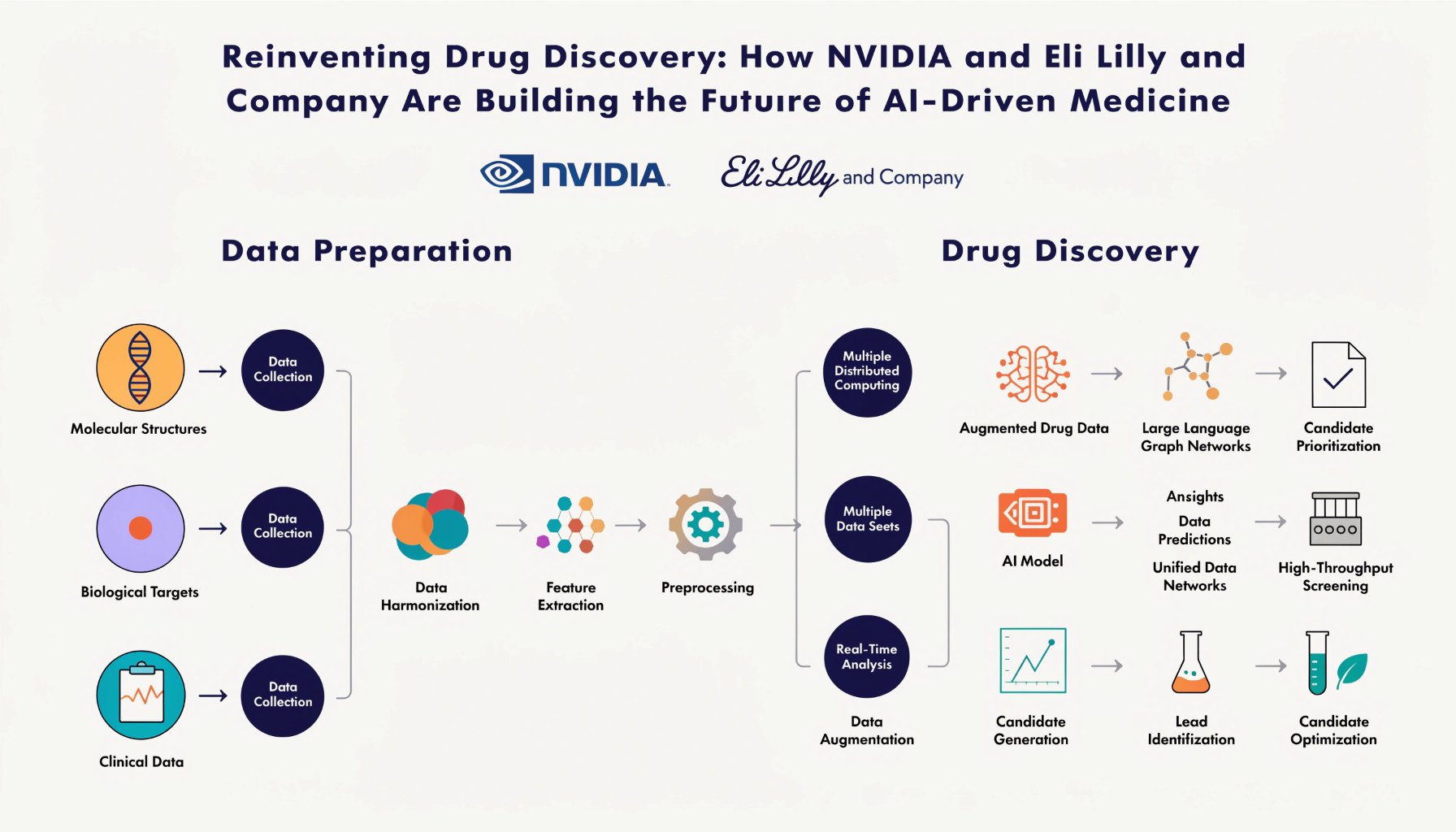
Artificial intelligence is rapidly transforming how new medicines are discovered, developed, and brought to market. In a significant move for the life sciences sector, NVIDIA and Eli Lilly have announced a co-innovation AI lab aimed at accelerating drug discovery through advanced computing and AI-driven research.
The collaboration highlights how technology and pharmaceutical leaders are aligning to address one of healthcare’s biggest challenges: reducing the time, cost, and complexity of developing new therapies.
Why AI Matters in Drug Discovery
Traditional drug discovery is a long and resource-intensive process, often taking years before a viable treatment reaches clinical trials. AI has the potential to dramatically change this by:
- Analyzing massive biological and chemical datasets
- Identifying promising drug candidates faster
- Improving prediction accuracy for molecule behavior
- Reducing trial-and-error in early research stages
By combining AI with high-performance computing, researchers can simulate, analyze, and iterate at a scale that was previously impossible.
The Role of the Co-Innovation AI Lab
The newly announced AI lab is designed to bring together expertise from both organizations. NVIDIA contributes advanced GPU computing platforms and AI frameworks, while Lilly brings deep pharmaceutical and clinical research knowledge.
The lab will focus on:
- Developing AI models for molecular discovery
- Enhancing data-driven research workflows
- Accelerating early-stage drug development
- Supporting scalable, secure research environments
This approach enables closer collaboration between AI engineers and life sciences researchers, helping move innovations from concept to application more efficiently.
Infrastructure and Computing at the Core
Behind AI-driven drug discovery lies powerful digital infrastructure. High-performance computing environments, optimized data pipelines, and secure research platforms are essential to support large-scale AI workloads.
Facilities and IT leaders supporting healthcare and life sciences organizations must consider:
- GPU-optimized data centers
- Scalable storage and compute resources
- Secure environments for sensitive research data
- Integration between on-premises and cloud platforms
The NVIDIA–Lilly collaboration underscores the growing importance of infrastructure readiness in enabling next-generation healthcare innovation.
Implications for Healthcare and Life Sciences
This partnership reflects a broader industry trend: AI is no longer experimental in healthcare—it is becoming foundational. As more organizations invest in AI labs and digital research environments, expectations around speed, collaboration, and data governance will continue to rise.
For healthcare facilities, research institutions, and pharmaceutical manufacturers, the message is clear: future innovation depends as much on technology infrastructure and facilities planning as it does on scientific discovery.
Final Perspective
The launch of a co-innovation AI lab by NVIDIA and Lilly represents a major step forward in AI-powered drug discovery. By combining advanced computing with pharmaceutical expertise, the collaboration aims to unlock faster, smarter pathways to new treatments.
As AI continues to reshape healthcare research, organizations that invest in the right infrastructure, partnerships, and governance frameworks will be best positioned to drive meaningful, scalable innovation.