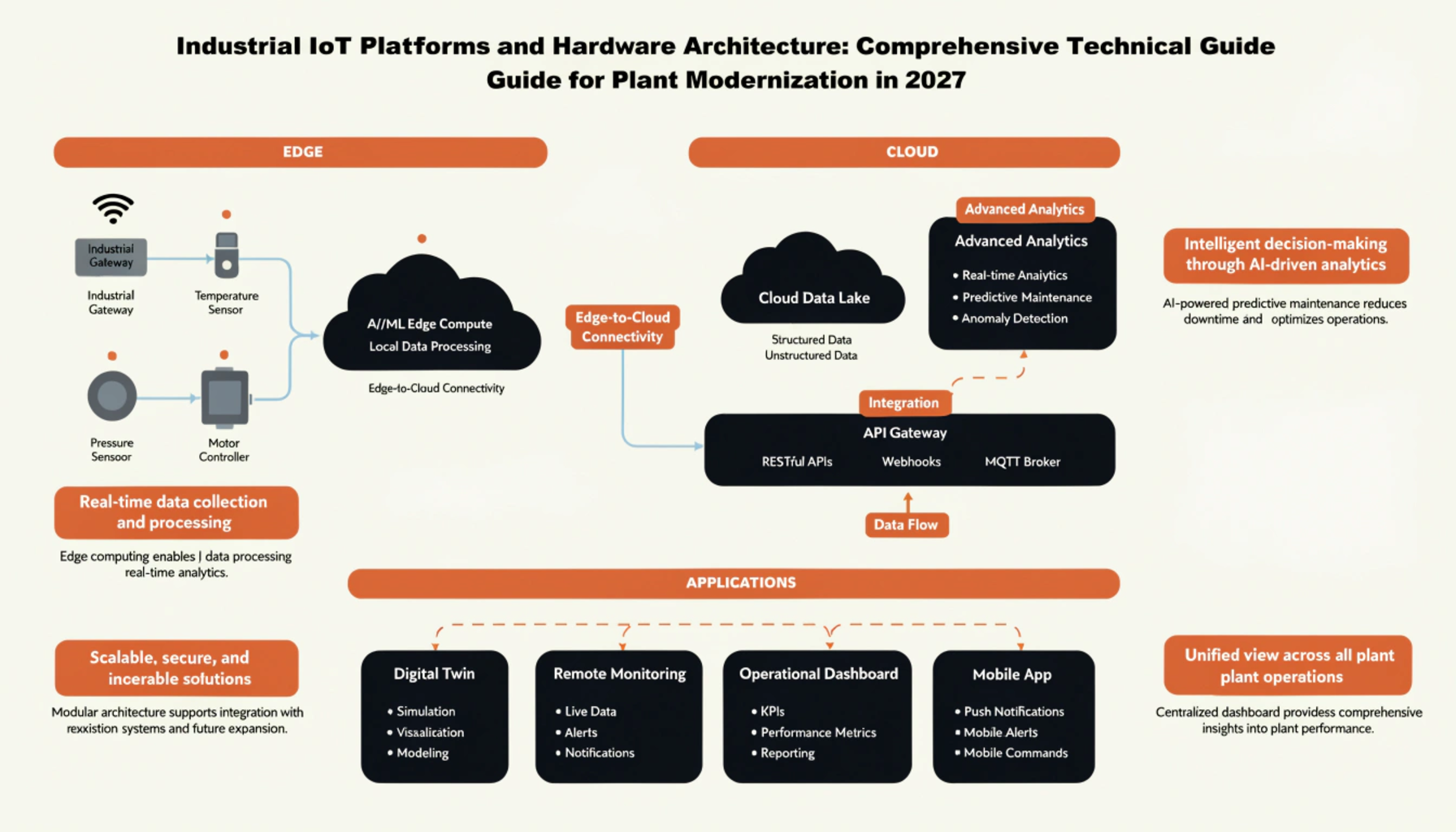
Modernizing industrial facilities requires bridging the gap between legacy production machinery and high-speed digital networks. Facility engineers and plant managers cannot simply replace functioning multi-million-dollar stamping presses, extrusion lines, or injection molders to achieve digital connectivity. Instead, plant retrofitting hinges on deploying intelligent hardware gateways, modern fieldbus adapters, and robust software platforms that extract operational data without disrupting active production cycles. The transition toward Industry 4.0 and Industry 5.0 concepts requires a deep architectural overhaul across sensors, edge nodes, network backbones, and enterprise analytics suites. By establishing clear standards for physical telemetry capture, real-time data translation, edge analytics, and zero-trust cybersecurity, organizations can unlock hidden manufacturing capacity, extend asset lifespans, and drive operational efficiency across complex multi-facility footprints.
Architectural Foundations for Plant-Floor Connectivity
Implementing connected plant systems starts at the physical sensor layer. Industrial facilities deploy non-invasive current transducers (CTs), tri-axial vibration accelerometers, thermal imaging arrays, pressure transducers, and optical infrared sensors across legacy drive assemblies, gearbox housings, and high-speed spindle bearings. These sensors continuously monitor machine health metrics, capturing high-frequency electrical and mechanical signals. For example, high-bandwidth piezoelectric accelerometers sample vibration frequencies up to 20 kHz to capture early-stage bearing inner race micro-spalling before thermal spikes occur. These raw signals are routed through shielded twisted-pair cabling or low-latency wireless field networks (such as WirelessHART or ISA100.11a) directly to ruggedized edge gateways positioned adjacent to machine control cabinets or housed inside protective IP67/NEMA 4X enclosures on the shop floor.
The next generation of industrial IoT platforms 2027 emphasizes decentralized edge computing over pure cloud processing. Because automated manufacturing lines operate on sub-millisecond cycle times, edge appliances process signal Fourier transforms (FFT), anomaly detection algorithms, and time-series aggregations locally. By filtering raw high-frequency telemetry at the machine level, facilities significantly reduce network bandwidth consumption while ensuring immediate emergency shutoff commands can be executed directly via local digital output (DO) channels if equipment tolerances are breached. This architecture protects plant continuity even during intermittent broadband outages, maintaining localized closed-loop control and data persistence via onboard non-volatile memory buffering.
Hardware Architecture for Edge and Cloud Interoperability
A robust industrial IoT hardware stack is structured across four primary layers: physical sensing, signal conditioning, edge compute aggregation, and network uplink backbones. Signal conditioning modules utilize high-resolution analog-to-digital converters (ADCs)—typically 24-bit resolution operating at sampling frequencies exceeding 100 kS/s per channel—to isolate low-amplitude sensor signals from background electromagnetic interference (EMI) prevalent in heavy industrial environments containing high-power variable frequency drives (VFDs) and arc welding equipment. Edge gateways, powered by multicore ARM Cortex-A72 or x86 Intel Atom/Xeon processors, execute real-time operating systems (RTOS) or lightweight Linux distributions optimized for containerized workloads using Docker, Podman, or WebAssembly micro-runtimes.
Redundancy is critical at the hardware layer to ensure high availability (99.999% operational uptime). Modern gateway architectures incorporate dual-SIM or eSIM cellular modems supporting 5G private network slices, dual gigabit Ethernet interfaces for local operational technology (OT) network segmentation, and onboard supercapacitors or uninterruptible power supply (UPS) circuits to prevent file system corruption during unexpected main bus voltage drops or sudden grid disconnects. Hardware security is embedded at initialization via secure bootloaders, physically unclonable functions (PUFs), and hardware Root of Trust (RoT) architecture.
Case Study: Automotive Stamping Plant Vibration Telemetry
A tier-one automotive stamping facility in Ohio retrofitted 14 heavy mechanical press lines with high-frequency tri-axial accelerometers connected to localized edge compute gateways. Prior to implementation, unplanned drive-gear failures caused an average of 42 hours of downtime annually, costing approximately $25,000 per idle hour. By deploying localized fast Fourier transform (FFT) analysis on edge gateways running containerized inference models, the plant detected gear tooth micro-pitting three weeks before structural failure. The maintenance team performed scheduled component replacements during off-shift hours, eliminating emergency downtime and generating an estimated $1.05 million in annualized operational savings.
Evaluating Vendor Solutions and Industrial Protocol Translation
A major engineering hurdle in factory retrofitting is protocol diversity and legacy fieldbus fragmentation. Production lines frequently mix legacy Modbus RTU/TCP controllers, Siemens MPI/PROFIBUS, Allen-Bradley Data Highway Plus (DH+), legacy serial communications, and modern Ethernet/IP or PROFINET devices. Leading IIoT vendors USA specialize in protocol translation hardware and unified data layers that convert disparate machine outputs into standardized formats like MQTT Sparkplug B, OPC UA (Open Platform Communications Unified Architecture), and RESTful APIs.
Platforms such as Rockwell Automation FactoryTalk, PTC ThingWorx, Emerson Ovation, Siemens MindSphere, and Advantech EdgeHub provide facility engineers with pre-configured connectors for industrial hardware. These platforms simplify the deployment of computerized maintenance management systems (CMMS), automated energy-monitoring dashboards, and predictive maintenance engines. By analyzing real-time power draw and harmonic distortion across distinct manufacturing cells, maintenance supervisors can isolate energy-wasting idle machinery, schedule targeted component overhauls, and optimize operational expenditure across multi-site enterprises. Standardizing telemetry model semantics via OPC UA Information Models allows seamless cross-platform orchestration between OT shop-floor devices and IT enterprise resource planning (ERP) suites like SAP S/4HANA or Oracle Fusion.
Comparative Analysis of Industrial IoT Software Platforms
Selecting the appropriate industrial software platform requires evaluating protocol support, cloud vendor compatibility, edge execution capability, and licensing models across leading vendors:
| Platform | Primary Strengths | Native Protocols | Edge Execution | Deployment Flexibility |
|---|---|---|---|---|
| PTC ThingWorx | Rapid CAD/PLM integration, Kepware connectivity | 150+ drivers via Kepware (Modbus, OPC UA, AB) | ThingWorx AlwaysOn micro-servers | Hybrid Cloud / On-Premises |
| Rockwell FactoryTalk | Deep integration with Allen-Bradley PLCs & Logix | EtherNet/IP, CIP, OPC UA, FactoryTalk Live Data | FactoryTalk Edge Gateway runtime | On-Premises / Azure Cloud integration |
| Siemens Industrial Edge / Insights Hub | Native S7 integration, Sinumerik CNC telemetry | S7 Protocol, PROFINET, OPC UA, MQTT | Siemens Industrial Edge Management OS | Managed Cloud / Local Edge Devices |
| Emerson Ovation / PACSystems | Process control, power generation & flow analytics | HART, Modbus TCP, OPC UA, Foundation Fieldbus | PACEdge Linux container runtime | Edge-heavy / On-Premises DCS |
Advanced Analytics, Machine Learning, and Digital Twins at the Edge
In 2027, the convergence of machine learning and physical simulation has driven the widespread adoption of real-time Digital Twins on the plant floor. Digital Twins provide dynamic virtual representations of physical assets, updated by continuous stream telemetry. By running physics-informed neural networks (PINNs) and reduced-order models (ROMs) directly on industrial edge hardware, facilities can simulate thermal stress, mechanical fatigue, and fluid dynamics without waiting for cloud compute roundtrips. These models ingest multidimensional sensor feeds to continuously compare expected physical behavior against actual operational metrics.
Predictive maintenance workflows leverage autoencoder neural networks and spectral vibration analysis to detect micro-anomalies in vibration spectra and current signatures long before acoustic or visual indicators manifest. Maintenance teams transition from calendar-based servicing to condition-based intervention, reducing catastrophic component failures and avoiding costly unplanned downtime across critical assembly lines. Advanced edge platforms also utilize generative AI assistants trained on technical maintenance manuals and historical repair logs, enabling field technicians to query machine diagnostics using natural language interfaces directly on handheld industrial tablets.
Case Study: Semiconductor Fab Cleanroom HVAC Digital Twin
A semiconductor fabrication facility in Texas deployed real-time Digital Twin models across its cleanroom environmental control units. Maintaining precise temperature (+/- 0.1 degrees Celsius) and relative humidity controls is essential to prevent wafer yield degradation. By running PINN algorithms on local edge servers connected to 350 micro-sensors, the system dynamically adjusted variable frequency drives on air handler units in anticipation of thermal load shifts caused by batch processing equipment. The predictive adjustments reduced cleanroom energy consumption by 18% and improved overall wafer yield by 1.4%, generating over $3.2 million in annual value.
Cybersecurity Architecture and Zero Trust Frameworks in IIoT
Connecting legacy operational technology (OT) to enterprise information technology (IT) networks significantly increases the potential cyber attack surface. Cyber-physical attacks targeting industrial control systems (ICS) can lead to physical safety hazards, production sabotage, or ransom-driven operational outages. Modern IIoT architectures enforce rigorous Zero Trust Network Access (ZTNA) policies based on ISA/IEC 62443 security standards. Edge gateways incorporate hardware-based Trusted Platform Modules (TPM 2.0) to store cryptographic keys, verify bootloader integrity, and authenticate device identities before establishing network sessions.
Micro-segmentation isolates plant-floor networks into distinct security zones and conduits following the Purdue Model for Control Hierarchy. This ensures that a compromised sensor or edge appliance cannot serve as a lateral entry point into safety-critical Programmable Logic Controllers (PLCs), Safety Instrumented Systems (SIS), or enterprise ERP networks. Encrypted WireGuard or IPsec VPN tunnels, combined with strict outbound-only MQTT connections over TLS 1.3, prevent unauthorized inbound access while supporting secure, audit-logged remote access for OEM maintenance specialists. Continuous OT threat monitoring solutions inspect network traffic at deep packet levels to flag unauthorized PLC ladder logic updates or unapproved parameter writes in real time.
Case Study: Chemical Processing Facility Zero Trust Deployment
A specialty chemical manufacturer operating five continuous-process distillation sites overhauled its OT security posture by implementing ISA/IEC 62443-compliant ZTNA architecture. The company retrofitted 85 field edge routers with hardware TPM 2.0 modules and implemented outbound-only MQTT Sparkplug B communication over encrypted TLS tunnels. During a third-party penetration testing audit, automated red teams were unable to breach the PLC control zone from simulated compromise points on the business network. The micro-segmentation architecture successfully contained potential security vectors while maintaining full data visibility for centralized cloud analytics.
Building Operational Resilience and Scalability
When designing an industrial IoT upgrade roadmap, facility directors must prioritize modular hardware enclosures, IP67-rated ingress protection, and redundant network drops. Integrating cellular 5G private networks alongside hardwired industrial Ethernet provides failover protection against local physical line damage. Private 5G networks offer dedicated frequency channels (such as CBRS bands in North America) that deliver ultra-reliable low-latency communication (URLLC) for mobile equipment like Automated Guided Vehicles (AGVs) and Autonomous Mobile Robots (AMRs) operating across large warehouse spaces.
Implementing automated uninterruptible power supplies (UPS) for edge gateway enclosures ensures that critical machine telemetry continues recording without interruption during localized voltage sags or emergency grid disconnects. By selecting interoperable platforms, standardized sensor hardware, and robust cyber-physical security frameworks, plant managers can incrementally digitize factory lines, realizing immediate maintenance savings while establishing a scalable, future-proof infrastructure for continuous operational optimization.
Upgrade Your Manufacturing Facility Infrastructure
Learn how to retrofit legacy industrial machinery with modern sensor arrays, deploy edge computing gateways, and cut unplanned plant downtime.