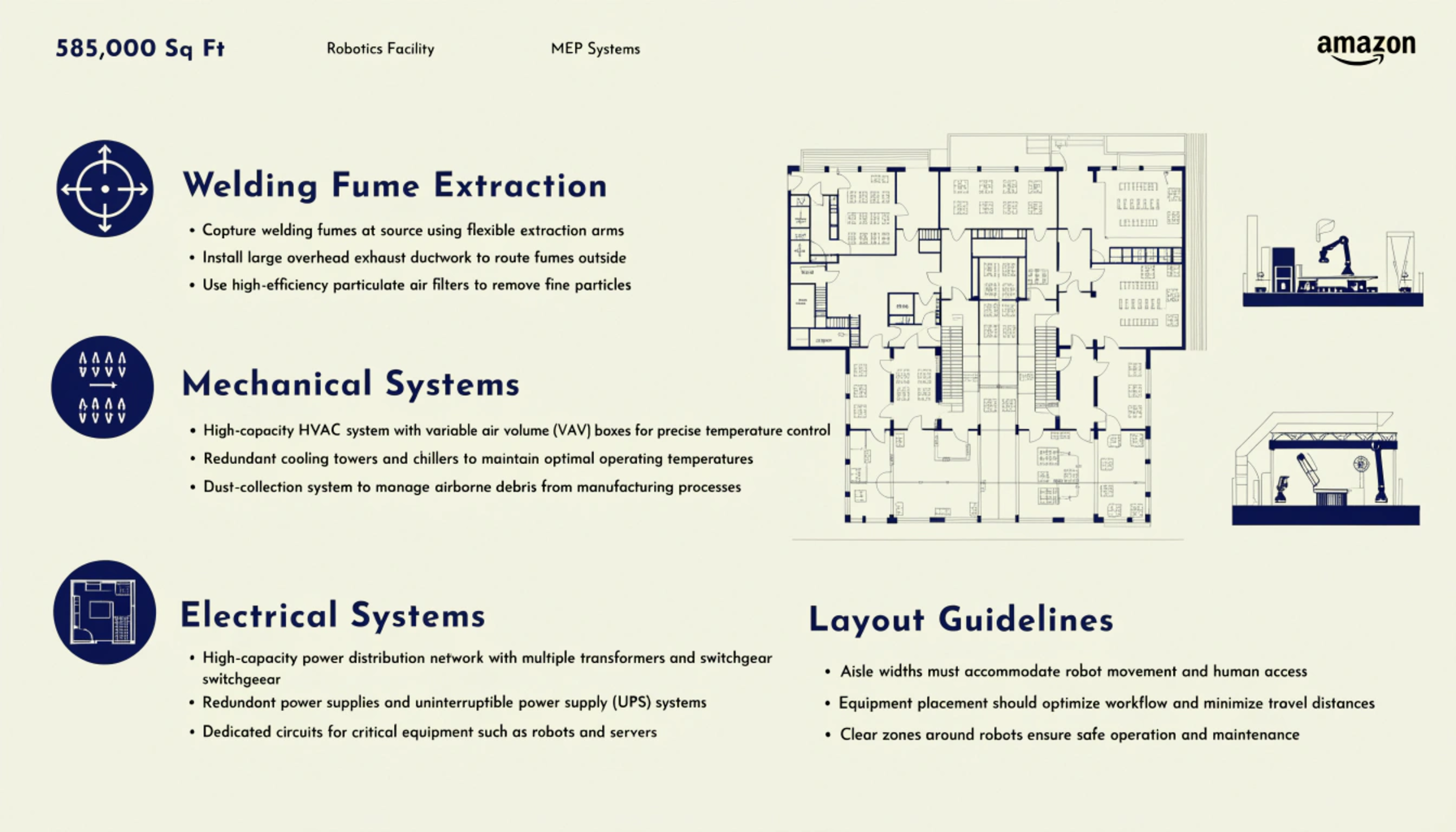
When Amazon announced its $100 million capital project in Greenwood, Indiana, on September 24, 2026, mainstream headlines focused on warehouse automation scaling and the creation of 300 skilled technical jobs. For industrial plant engineers, facility directors, and MEP contractors, however, the real focus is on the sophisticated physical infrastructure required to engineer a 585,000-square-foot advanced manufacturing facility. Fabricating autonomous mobile robots (AMRs), heavy robotic arms, and drive-train sub-assemblies requires an intricate industrial environment combining high-power CNC machining, automated robotic welding, electrostatic powder coating, and precision electronic calibration under one roof, establishing a new benchmark for robotics manufacturing facility USA construction.
Designing and retrofitting a facility of this magnitude involves severe engineering challenges: managing heavy electrical transformer inrush loads, mitigating robotic weld fume hazards, designing clean powder-coating cure ovens, and providing floor slab stability for multi-axis fabrication tools. Amazon’s Greenwood campus serves as an outstanding case study in modern factory architecture, demonstrating the engineering requirements behind the latest wave of U.S. manufacturing investment 2026.
The transition from traditional logistics fulfillment centers to high-rate mechatronic manufacturing plants represents a fundamental shift in industrial design philosophy. Where standard fulfillment operations prioritize maximum cubic storage utilization and linear material throughput, a robotics production campus must function as a integrated precision tool. Every square foot of space requires meticulous environmental conditioning, active vibration damping, multi-tiered power quality management, and ultra-responsive safety systems to safeguard both high-precision machinery and human technical specialists.
Plant Floor Layout and Zoned Intralogistics
In standard logistics warehouses, floor layout is optimized for pallet rack storage and wide forklift aisles. In an advanced robotics manufacturing plant, however, spatial flow is governed by continuous, synchronous workcell feeding. Raw structural steel tubes, aluminum billets, cast gearboxes, and printed circuit board assemblies must move seamlessly through fabrication, welding, coating, assembly, and testing bays without material back-tracking.
To support uninterrupted production cycles, the intralogistics architecture utilizes an automated material handling backbone. Overhead monorail systems, autonomous tuggers, and smart AGV transfer carts continuously transport components between raw material staging areas and fabrication cells. Dynamic buffering zones equipped with automated storage and retrieval systems (ASRS) prevent bottlenecks across process handoffs, ensuring work-in-progress (WIP) inventory flows without human intervention or manual fork-truck congestion.
Facility engineering teams configure the 585,000-square-foot envelope into five segregated, high-throughput manufacturing zones:
- Zone 1: Raw Material Intake and Precision CNC Machining: Heavy structural bays featuring reinforced slab foundations support multi-axis CNC horizontal machining centers, laser tube cutters, and hydraulic press brakes.
- Zone 2: Automated Robotic Welding and Structural Fabrication: Enclosed robotic welding cells equipped with automated part positioners and dual-station turn-tables execute high-precision MIG and TIG structural welds on robot chassis frames.
- Zone 3: Automated Wash, Pretreat, and Powder Coating: An enclosed overhead conveyor line conveys welded frames through multi-stage alkaline degreasing, iron phosphate conversion baths, automated powder spray booths, and high-efficiency convection curing ovens.
- Zone 4: Clean Mechatronic Final Assembly and Wiring: Pressurized, climate-controlled assembly bays where technicians and collaborative robots integrate brushless servo motors, planetary gearboxes, lidar sensors, and lithium battery management systems.
- Zone 5: Automated Testing, Burn-In, and Calibration Tracks: Dedicated flat-floor proving grounds equipped with optical calibration targets and dynamometer test rollers verify AMR obstacle detection, path tracking, and battery charging cycles under simulated load.
Environmental and Mechanical Systems: Robotic Welding Fume Extraction
Robotic welding of carbon steel and structural aluminum generates substantial volumes of sub-micron particulate fumes, including hazardous manganese, iron oxide, and hexavalent chromium aerosols. Under OSHA standards and NFPA guidelines, welding fumes must be captured at the source before dispersing into general ambient plant air.
Facility engineers must design comprehensive environmental exhaust systems:
Industrial ventilation design must reconcile competing requirements: achieving high-velocity source extraction while preserving the protective inert shielding gas shields necessary for defect-free welds. If exhaust air velocities at the weld torch tip exceed critical thresholds, turbulence can pull ambient air into the weld pool, causing severe porosity, oxidation, and structural joint failure in robot frame chassis assemblies.
- Source-Capture Fume Hoods and Push-Pull Air Curtains: Each robotic welding cell features custom close-capture hoods integrated directly with robot safety enclosures. Low-velocity push-pull air systems sweep thermal plumes upward into dedicated exhaust ductwork without disrupting protective shielding gas envelopes.
- Centralized Downflow Cartridge Dust Collectors: Fume ductwork routes to exterior centralized cartridge filtration systems equipped with flame-retardant nanofiber media (rated MERV 16 or HEPA). Differential pressure monitoring automatically triggers compressed-air reverse-pulse cleaning cycles.
- Secondary Ambient Destratification and Air Exchange: The general fabrication hall utilizes high-volume low-speed (HVLS) fans paired with rooftop make-up air units (MAUs) providing 6 to 8 complete air changes per hour (ACH) to maintain pristine indoor air quality.
- Real-Time Air Quality Monitoring and Automated VFD Control: Optical particle counters and gas sensor arrays deployed across the welding hall continuously monitor PM2.5 and volatile organic compound (VOC) levels. These sensors interface with variable frequency drives (VFDs) on main collector blowers, dynamically ramping air volume up or down based on active weld cell count.
Thermal Engineering: Automated Powder Coating and Curing Ovens
Applying durable protective powder coating to robotic chassis frames requires tight thermal process control. Uncured powder must be baked at 375°F to 400°F (190°C to 204°C) for 15 to 20 minutes to cross-link polymer resins into an impact-resistant, corrosion-proof shell.
Facility mechanical systems must optimize oven energy performance:
Proper thermal profiling across curing chambers is essential to prevent part warpage and ensure consistent coating thickness. Advanced multi-zone infrared convection hybrid ovens utilize pulse-width modulated heating element banks that precisely adjust heat input according to part mass and surface geometry, guaranteeing uniform temperature cross-linking across heavy structural tubular steel and thin-sheet frame panels alike.
- Air-Seal Entrances and Thermal Curtains: Continuous overhead conveyor openings utilize aerodynamic high-velocity air seals that prevent oven heat from spilling onto the manufacturing floor, keeping ambient plant temperatures comfortable.
- Indirect-Fired Natural Gas Burners with Flue Heat Recovery: Oven burners utilize modulating low-NOx gas trains. Flue gas heat exchangers recover exhaust thermal energy to pre-heat incoming dry-off oven chambers, reducing plant gas consumption by over 25%.
- Automated Powder Recovery Cyclones: Spray booths incorporate multi-cyclone recovery systems and cartridge final filters, capturing oversprayed powder paint for re-blending and achieving a 98% powder utilization rate.
Electrical Distribution and Power Quality Conditioning
Operating dozens of high-speed CNC spindle motors, robotic welding power sources, infrared cure lamps, and compressor banks imposes severe instantaneous electrical demands. Resistance welders and variable frequency drives (VFDs) generate sharp current spikes and harmonic distortions that can disrupt sensitive digital logic controllers in adjacent assembly zones.
Facility electrical engineers implement robust power conditioning:
In addition to voltage sags and harmonic distortion, rapid load switches from multi-axis servo drives and high-frequency welding power supplies generate significant electrical noise along ground paths. Unconditioned ground noise can introduce transient errors in precision electronic sensor calibration and optical encoder feedback during robot programming phases. Mitigating these issues requires clean, dedicated isolation transformers and isolated grounding grids throughout electronic assembly and calibration stations.
- Dedicated Substation Isolation: High-power fabrication and welding cells are served by dedicated 480V substation transformers isolated from clean electronics assembly and testing loops.
- Active Harmonic Filtering (AHF) and Transient Voltage Surge Suppression (TVSS): Shunt-connected active harmonic filters attenuate 5th and 7th harmonic frequencies, ensuring total harmonic distortion (THD) remains below 5% per IEEE 519 standards.
- Overhead Busway Power Distribution: Instead of rigid conduit drops, high-capacity modular overhead busways run above CNC and assembly rows, allowing quick-disconnect power tap-off boxes to be re-positioned in minutes when line configurations shift.
Structural Slab Design and Vibration Decoupling
High-precision 5-axis CNC machining centers and coordinate measuring machines (CMMs) cannot tolerate ground vibration induced by adjacent heavy stamping presses or heavy freight traffic. Engineering teams specify 10- to 12-inch reinforced concrete machine pads anchored to bedrock, separated from the general plant slab by 2-inch elastomeric vibration-isolation joints.
In addition to structural isolation joints, slab engineering specifications must satisfy strict surface flatness and levelness standards (FF/FL numbers exceeding 50/50). Precision floor tolerances are mandatory across optical testing tracks and AMR calibration runways, where sub-millimeter level variance is necessary to ensure target alignment during automated camera, lidar, and inertial measurement unit (IMU) calibration protocols.
Smart Building Management and Industrial IoT Integration
Modern robotics manufacturing facilities rely on centralized Building Management Systems (BMS) integrated with industrial Internet of Things (IIoT) architecture. Thousands of smart telemetry nodes monitor compressed air pressure, chilled water flow, power consumption, and environmental metrics in real time. Predictive maintenance algorithms analyze vibration signatures on critical exhaust blowers and air compressor turbines, detecting early mechanical wear before unplanned downtime disrupts plant operations.
Conclusion: The Blueprint for Advanced Robotics Manufacturing
Amazon’s $100 million manufacturing campus in Greenwood, Indiana, exemplifies the high level of facility engineering required to build next-generation automation. By mastering zoned layout flow, source-capture welding ventilation, energy-efficient curing ovens, and isolated electrical distribution, the facility establishes a premier standard for a modern robotics manufacturing facility USA, providing an exceptional model for future U.S. manufacturing investment 2026 projects.
Optimize Your Advanced Manufacturing Facility Infrastructure
Interested in smart factory leadership and industry events? Learn more about the Smart Manufacturing & Automation Convention 2027.