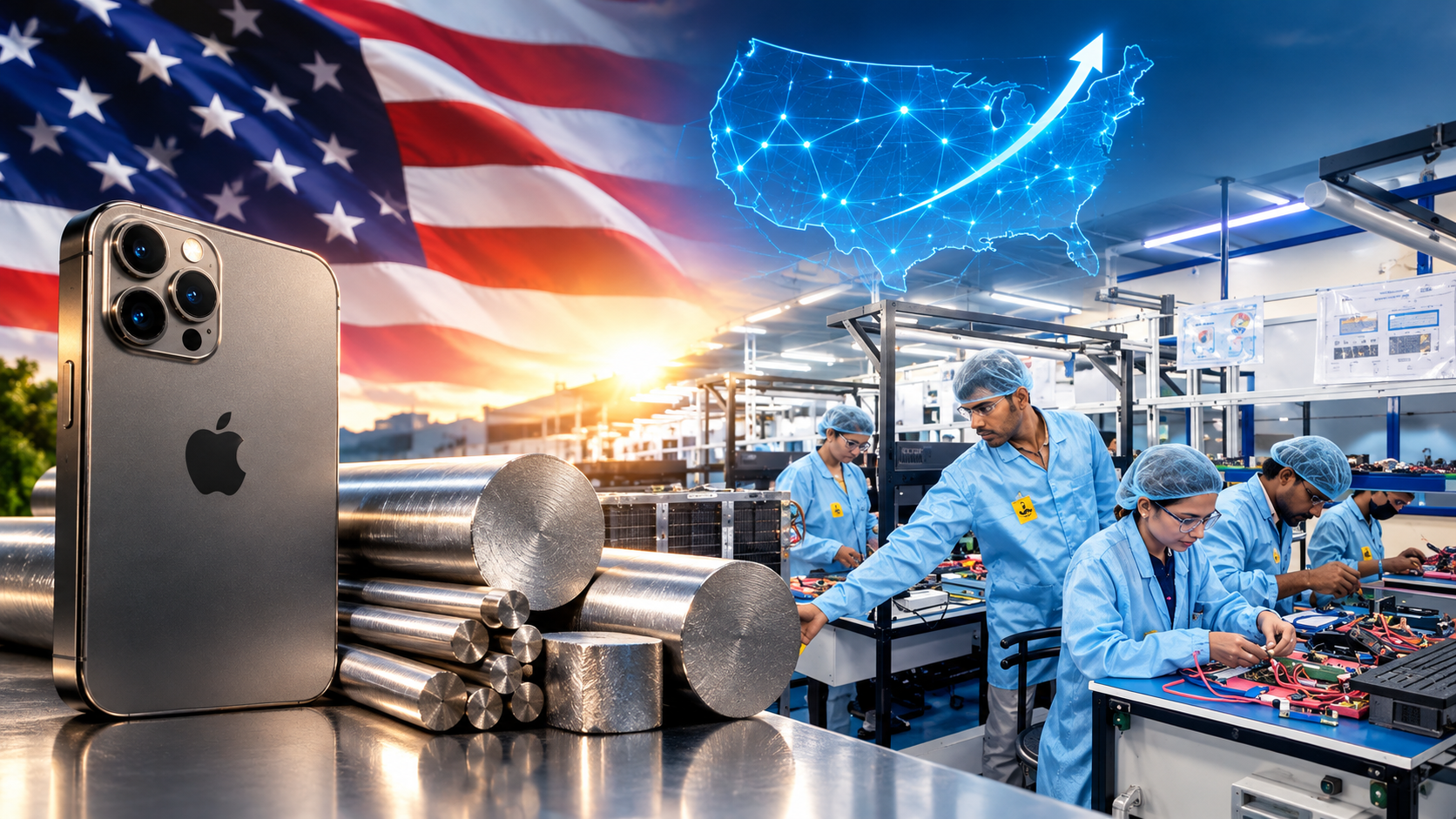
Apple has long been associated with global manufacturing. But its latest move suggests that the company is increasingly looking closer to home for some of the critical materials and technologies behind its products.
On October 20, 2026, Apple announced that it will commit up to $100 million over three years to Pennsylvania-based Perryman Company for U.S.-produced titanium. The titanium will be used in Apple products, including the enclosure of its first foldable iPhone, the iPhone Duo.
At first glance, $100 million may appear to be a relatively small investment compared with Apple’s broader manufacturing plans. But the significance goes beyond the dollar value.
The deal highlights a much larger shift in Apple U.S. manufacturing: moving more advanced materials, semiconductor production, components and manufacturing capabilities into the American supply chain.
Apple says nearly 100 components used across the iPhone Duo and iPhone 18 Pro are now produced by American companies in more than a dozen states. Meanwhile, TSMC’s Arizona facility is producing more than 100 million chips for Apple in 2026.
Together, these developments raise an important question:
Is Apple helping create a new model for American manufacturing one built around advanced materials, semiconductors, automation and smart manufacturing?
Apple’s $100 Million Titanium Investment: What Changed?
The latest announcement centers on Perryman Company, a Pennsylvania-based manufacturer specialising in titanium products.
Under the agreement, Apple will commit up to $100 million over three years. Perryman will produce Grade 5 titanium for Apple products at its Houston, Pennsylvania facility, where the company melts, forges and rolls titanium containing at least 80% recycled content. Apple
The titanium will be used for products such as the iPhone Duo, giving the announcement an important connection to one of Apple’s newest product categories.
But the bigger story is where the material comes from.
Rather than relying entirely on overseas sources for a critical advanced material, Apple is increasing its relationship with an American manufacturer.
This is an important development for U.S. manufacturing because advanced manufacturing depends not only on final assembly. It also requires a reliable ecosystem of companies capable of producing metals, electronic components, semiconductor materials, precision components and specialised technologies.
Apple’s titanium deal is therefore one piece of a much larger industrial puzzle.
Why Titanium Matters to Advanced Manufacturing
Titanium is valued for its combination of strength, durability and relatively low weight. These characteristics make it useful in industries ranging from aerospace and medical equipment to electronics and defence.
For consumer electronics, the ability to manufacture precision titanium components at scale can require sophisticated processes, specialised equipment and highly controlled production environments.
That makes titanium manufacturing a good example of what modern advanced manufacturing looks like.
It is not simply about producing more products. It is about producing highly engineered materials with greater precision, consistency and efficiency.
Apple’s partnership with Perryman also highlights another trend: the growing relationship between manufacturing and sustainability.
Apple says Perryman’s titanium production for the company will contain at least 80% recycled content. Apple also says its direct suppliers are required to power their Apple manufacturing operations with renewable energy by the end of the decade. Apple
This combination of advanced materials, recycling and renewable energy could become increasingly important as manufacturers attempt to reduce the environmental impact of large-scale production.
Apple’s Manufacturing Push Goes Far Beyond Titanium
The titanium announcement is only one part of Apple’s broader strategy.
In 2025, Apple announced a $600 billion, four-year commitment to U.S. manufacturing and innovation. The company has since expanded partnerships with numerous American suppliers and manufacturing companies.
The objective is not to manufacture every Apple product entirely in the United States.
Instead, Apple is expanding domestic capacity across selected parts of the supply chain.
This includes semiconductors, glass, wireless components, advanced materials, camera technologies, AI servers and other critical technologies.
That distinction matters.
Modern manufacturing is global, and Apple’s products still depend on international supply networks. But increasing domestic production of strategically important components can give companies greater supply-chain flexibility.
For American manufacturers, this creates opportunities to move further into higher-value production.
TSMC Arizona Shows How U.S. Semiconductor Manufacturing Is Growing
One of the strongest examples is Apple’s relationship with TSMC’s Arizona semiconductor operations.
Apple says TSMC’s Arizona facility will produce more than 100 million chips for Apple in 2026. These chips are used across products including the iPhone, iPad and Apple Watch. Apple
This is significant because semiconductor manufacturing has traditionally been heavily concentrated in Asia.
Expanding advanced chip production in Arizona creates another source of semiconductor capacity within the United States.
It also demonstrates how Apple manufacturing is becoming connected to the growth of the American semiconductor ecosystem.
The shift is not happening through a single factory.
It involves fabs, materials suppliers, packaging and testing facilities, equipment manufacturers and technology companies working together.
For example, Apple says Amkor Technology’s new high-volume packaging and testing facility in Peoria, Arizona, is expected to support more than 3,500 local hires during its first phases, with Apple among its first customers. Apple
This creates a broader manufacturing network rather than simply another production facility.
Nearly 100 Components Are Now Made by American Companies
Another important detail from Apple’s announcement is the number of components being produced domestically.
Apple says nearly 100 components across the iPhone Duo and iPhone 18 Pro are produced by American companies, with suppliers located across more than a dozen states. Apple
These components cover different parts of the technology ecosystem.
Broadcom, for example, is expanding and modernising its facility in Fort Collins, Colorado, under a $1.5 billion investment. Apple says the multiyear agreement will produce more than 15 billion U.S.-made chips.
Corning’s facility in Harrodsburg, Kentucky, is another example. Apple says that by the end of 2026, the facility will produce all cover glass for iPhones and Apple Watches sold worldwide.
Coherent is also supplying laser technology from its Sherman, Texas, facility for technologies including Face ID. Apple
These examples show why American manufacturing is becoming more than a conversation about bringing factories back.
It is about creating an ecosystem capable of supporting increasingly sophisticated products.
What Does This Mean for U.S. Manufacturing?
Apple’s strategy could have a significant ripple effect across the manufacturing industry.
When a company of Apple’s scale increases its domestic sourcing, suppliers have stronger incentives to expand capacity, invest in equipment and develop new capabilities.
That can potentially create opportunities for:
- Semiconductor manufacturers
- Precision metal manufacturers
- Automation companies
- Industrial technology providers
- Advanced materials companies
- Engineering firms
- Equipment manufacturers
- Packaging and testing companies
This is where U.S. manufacturing growth becomes particularly interesting.
The demand generated by major technology companies can encourage suppliers to modernise their operations.
Instead of competing primarily through low-cost production, manufacturers can increasingly compete through automation, quality, speed, innovation and specialised expertise.
Smart Manufacturing Could Become the Next Competitive Advantage
As domestic manufacturing expands, simply building factories will not be enough.
Manufacturers will need to operate those facilities efficiently.
This is where smart manufacturing enters the picture.
Smart factories use technologies such as artificial intelligence, automation, robotics, industrial IoT, connected equipment and real-time data to improve production.
For a manufacturer producing advanced titanium components or semiconductor materials, these technologies can help monitor production quality, identify equipment problems and optimise processes.
The same principle applies across Apple’s expanding American supply chain.
More domestic production means more demand for facilities that can operate at high levels of efficiency and precision.
This could accelerate investment in digital manufacturing technologies across the United States.
Apple itself has already been investing in manufacturing education and technology. Its Advanced Manufacturing Center in Houston is designed to provide training in advanced manufacturing processes to students, supplier employees and American businesses. Apple
Apple also operates the Apple Manufacturing Academy in Detroit, which provides small and medium-sized manufacturers with hands-on training in areas including AI, automation and smart manufacturing. Apple
This suggests that workforce development is becoming another important part of the manufacturing equation.
The Workforce Challenge Behind the Manufacturing Boom
More factories do not automatically mean more manufacturing success.
Companies also need people who understand robotics, automation, AI, industrial software, engineering and advanced production processes.
As American factories become more technologically advanced, the definition of a manufacturing job is changing.
The modern manufacturing workforce increasingly needs to understand both physical production and digital systems.
That creates an opportunity for manufacturers, educational institutions and technology companies to collaborate on workforce development.
Apple’s manufacturing training initiatives are an example of this approach.
The company is not only investing in physical production capacity but also in the skills required to operate increasingly sophisticated facilities. Apple
Could Apple’s Strategy Influence Other Companies?
Apple’s enormous purchasing power gives it a unique position, but its strategy could influence other companies.
When major manufacturers increase domestic sourcing, suppliers may have greater confidence in making long-term investments in U.S. facilities.
Other technology, automotive, aerospace and industrial companies could pursue similar strategies where domestic capacity makes economic or strategic sense.
This could contribute to a broader transformation of the U.S. supply chain.
However, the shift will not happen overnight.
Building semiconductor fabs, advanced materials facilities and specialised production plants requires billions of dollars, highly skilled workers and years of development.
The result is likely to be a hybrid manufacturing model: global supply chains combined with stronger domestic capabilities in strategically important areas.
The Bigger Picture: From “Made in America” to “Advanced Made in America”
Perhaps the most interesting aspect of Apple’s latest move is what it says about the future of American manufacturing.
The conversation is gradually moving beyond simply asking whether a product is “Made in America.”
The more important question may be:
What level of technology and capability can America manufacture competitively?
Apple’s titanium investment, TSMC’s Arizona chip production and the expansion of American suppliers point toward a future where U.S. factories increasingly focus on high-value, technology-intensive production.
That includes semiconductors.
It includes advanced materials.
It includes AI infrastructure.
It includes precision components.
And increasingly, it includes smart manufacturing.
Apple’s $100 million titanium commitment may therefore be much more than a single supplier agreement.
It is another signal that the American manufacturing landscape is evolving and that companies capable of combining advanced technology, skilled workers, automation and resilient supply chains could be positioned to benefit.
What Comes Next for U.S. Manufacturing?
Apple’s latest announcement provides a glimpse into what the next phase of manufacturing could look like.
A stronger domestic supply chain will require continued investment in infrastructure, workforce development, automation, digital technologies and advanced production capabilities.
The companies that succeed may not simply be the ones that build more factories.
They will be the ones that build smarter factories.
For manufacturers, suppliers and technology providers, Apple’s expanding U.S. footprint could serve as a case study in how major companies are rethinking sourcing, production and supply-chain resilience.
The $100 million titanium agreement is only one part of that story.
The larger story is the emergence of a more connected American manufacturing ecosystem one where advanced materials, semiconductors, AI, automation and skilled workers come together to create the next generation of industrial production.
And that could make Apple’s latest manufacturing investment worth watching far beyond the technology industry.
Build the Future of Smart Manufacturing
The transformation of American manufacturing is creating new opportunities for manufacturers, technology providers and industry leaders. Smart manufacturing and automation will play a critical role in building more efficient, resilient and competitive production facilities.
Want to explore where the industry is heading and connect with manufacturing and automation leaders?
Join the Smart Manufacturing & Automation Convention 2027 to discover emerging technologies, industry trends and opportunities shaping the future of manufacturing.
Explore the Smart Manufacturing & Automation Convention 2027 →