For generations, the heartbeat of American manufacturing was measured in heavy steel, towering assembly lines, brute physical labor, and massive capital expenditures poured straight into physical infrastructure. If you wanted to build more cars, aircraft, or defense hardware, the playbook was straightforward: buy more land, pour more concrete, install heavier machinery, and hire an army of floor operators. Physical scale equaled market dominance.
Today, that paradigm is undergoing a violent, high-stakes evolution. Across the United States, industrial heavyweights and visionary tech disruptors are making multi-billion-dollar bets on a radical new premise: that the future of making things has very little to do with how much physical steel you can move, and everything to do with the intelligence of the code controlling it.
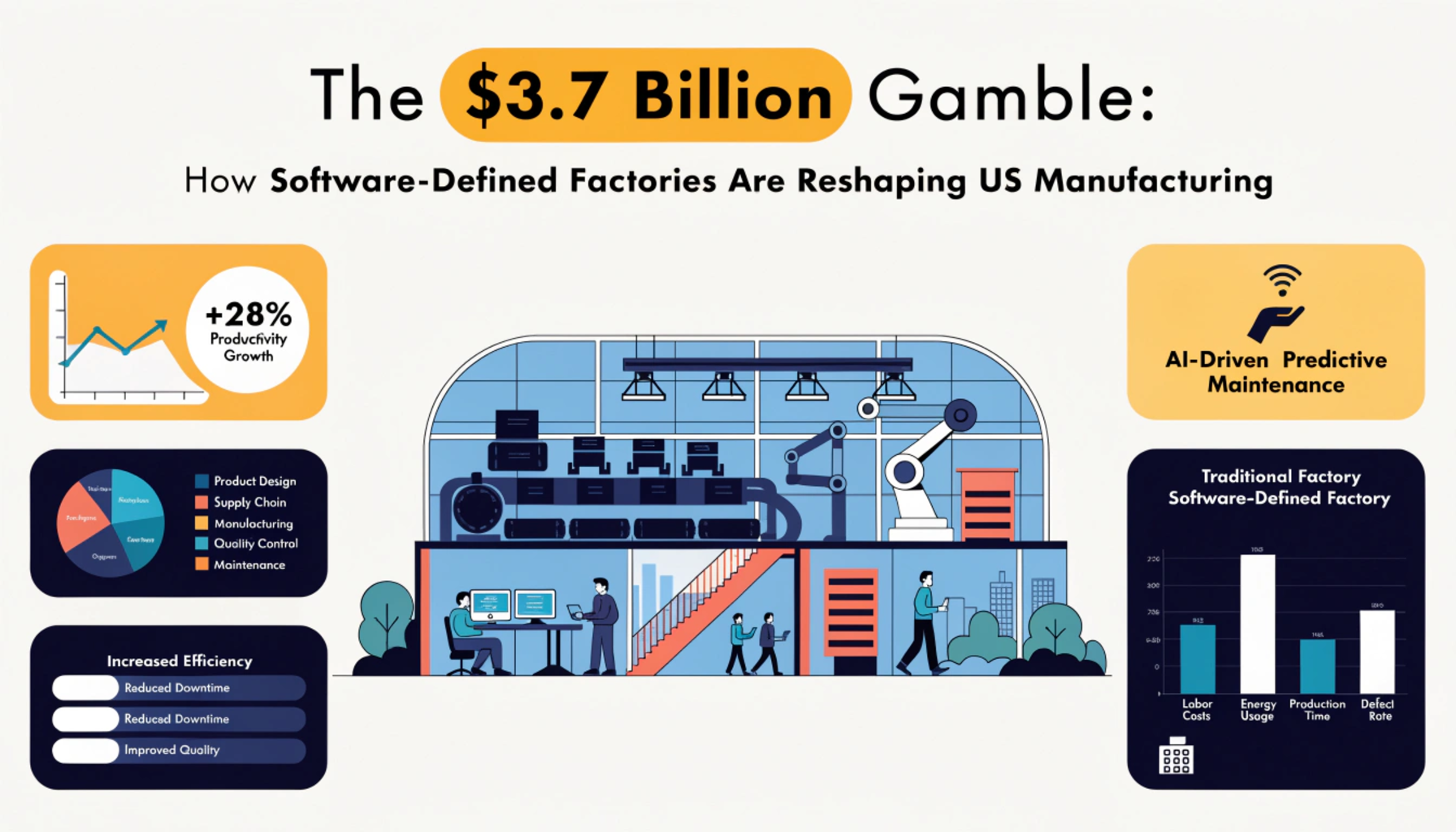
At the center of this industrial pivot is a monumental $3.7 billion gamble on software-defined factories a movement that is fundamentally rewriting the economics, agility, and architecture of US manufacturing. But what does it truly mean to decouple hardware production from rigid physical lines, and why is this transition becoming a do-or-die mandate for the American industrial base?
The Shift from Brute Force to Programmable Production
To understand why a $3.7 billion gamble is capturing the attention of executive boards and defense strategists alike, we must first look at the structural bottlenecks plaguing traditional production lines. For decades, traditional manufacturing facilities suffered from rigid operational silos. If a tooling error occurred, or if global supply chain disruptions starved a plant of specific physical components, retooling the physical floor took months, often costing millions of dollars in downtime.
Enter the concept of software-defined factories. Borrowing a page from cloud computing and software architecture, where physical servers were long ago abstracted into virtual, easily reconfigurable environments, modern industrial innovators are applying the same logic to heavy manufacturing. In a software-defined facility, the physical machinery acts as a flexible, programmable canvas. The core logic, quality control, tool paths, and production sequencing are governed by dynamic software layers, artificial intelligence, and edge-computed telemetry.
This means a plant can pivot from manufacturing Variant A to Variant B not by tearing down physical conveyors or swapping out massive hard-to-source jigs, but by updating control algorithms, executing digital twin simulations, and deploying automated reconfiguration routines over secure industrial networks.
Why Capital is Pouring Into Software-Defined Operations
The willingness of enterprises to inject billions of dollars into software-driven production models stems from three inescapable industrial pressures:
- Unforgiving Lead Times and Backlogs: Traditional procurement and manufacturing channels have repeatedly buckled under modern demand. Whether in aerospace, defense, or high-tech automotive sectors, multi-year backlogs prove that throwing more manual labor and concrete at a bottleneck no longer works.
- The Imperative of Agility: Geopolitical shifts and volatile global supply chains demand a manufacturing ecosystem that can absorb shocks instantly. Programmable production lines offer the modularity required to scale output up or down without catastrophic financial exposure.
- Data as a Primary Input: In a software-defined model, every single machine, sensor, and robotic arm acts as a data-emitting node. This creates a closed-loop feedback system where predictive maintenance, autonomous quality assurance, and generative process optimization continuously refine output in real time.
Re-Engineering the Factory Floor: Core Pillars of Modern Industrial Tech
Transitioning to a software-defined ecosystem requires more than just installing a few cloud dashboards. It requires a total rethinking of how OT (Operational Technology) and IT (Information Technology) converge.
1. The Digital Twin as the Master Blueprint
Before a single physical component is forged, the entire factory lifecycle from raw material ingestion to final assembly and stress testing is simulated inside a high-fidelity digital twin. Engineers can test thousands of stress scenarios, optimize robotic payloads, and identify thermal or mechanical bottlenecks virtually. By ironing out inefficiencies in code, companies protect themselves from catastrophic physical mistakes on the shop floor.
2. Edge Computing and Autonomous Process Control
In legacy systems, data traveled from factory floor sensors up to distant corporate servers and back down, introducing latency that made real-time automated correction impossible. Modern smart manufacturing environments leverage robust edge computing architectures. Localized servers process millions of data points per second right next to the machinery, allowing autonomous robotics and cobots to make micro-adjustments to torque, speed, and alignment instantly.
3. Resilient Industrial Workforces
A common misconception is that software-defined automation eliminates the human element entirely. In practice, it elevates it. As routine, hazardous physical monitoring is handed over to software-driven systems, human operators transition into high-value roles: systems architects, data analysts, reliability engineers, and digital transformation leads. The factory floor becomes less of a sweatshop and more of a high-tech control center.
Overcoming the Friction: Risks, Realities, and Cultural Inertia
Of course, a multi-billion-dollar transformation does not happen without friction. Betting heavily on unproven software paradigms and massive capital outlays carries deep inherent risks.
- Integration Complexity: Marrying legacy industrial machinery with cutting-edge software layers is notoriously difficult. Many facilities struggle with “brownfield” integration trying to make 20-year-old hydraulic presses talk smoothly to modern IoT cloud protocols.
- Cybersecurity Vulnerabilities: As factories become software-defined, they also become software-targetable. Expanding the digital attack surface opens industrial networks to sophisticated cyber threats capable of sabotaging physical critical infrastructure. Securing the operational perimeter is no longer just an IT checkbox; it is a matter of national security.
- The Skills Gap: Finding engineers who understand both mechanical metallurgy and advanced software deployment remains a primary bottleneck for industrial growth. Upskilling existing plant talent is an urgent operational priority.
Despite these hurdles, the market has made its verdict clear. Companies clinging exclusively to analog methodologies are finding themselves structurally uncompetitive against agile, software-driven competitors who can out-innovate and out-scale them at every turn.
The Path Forward: Where the Industry Goes Next
As we look toward the future of US manufacturing, the multi-billion-dollar investments currently making headlines are merely the opening salvo. The ultimate goal is a fully synchronized, self-healing national industrial network where supply chain nodes communicate autonomously, predictive algorithms prevent downtime before it manifests, and production capacity can be dynamically allocated to meet critical national and commercial demands.
Achieving this vision requires more than just corporate investment; it requires continuous peer collaboration, rigorous cross-industry dialogue, and a shared roadmap for overcoming integration and workforce hurdles. The transition from physical rigidity to digital fluidity is the defining industrial challenge of our decade.
Join the Conversation on the Future of Production
The theoretical window for digital adoption has closed; the era of practical execution is here. If your organization is navigating the complexities of digital twins, advanced robotics, IIoT, and enterprise-scale industrial automation, you don’t have to navigate the evolution alone.
Connect with fellow manufacturing executives, operations leaders, and visionary technology providers who are actively building the next generation of resilient industrial ecosystems. Explore upcoming industry forums designed to move past the expo noise and foster real, actionable operational strategies.