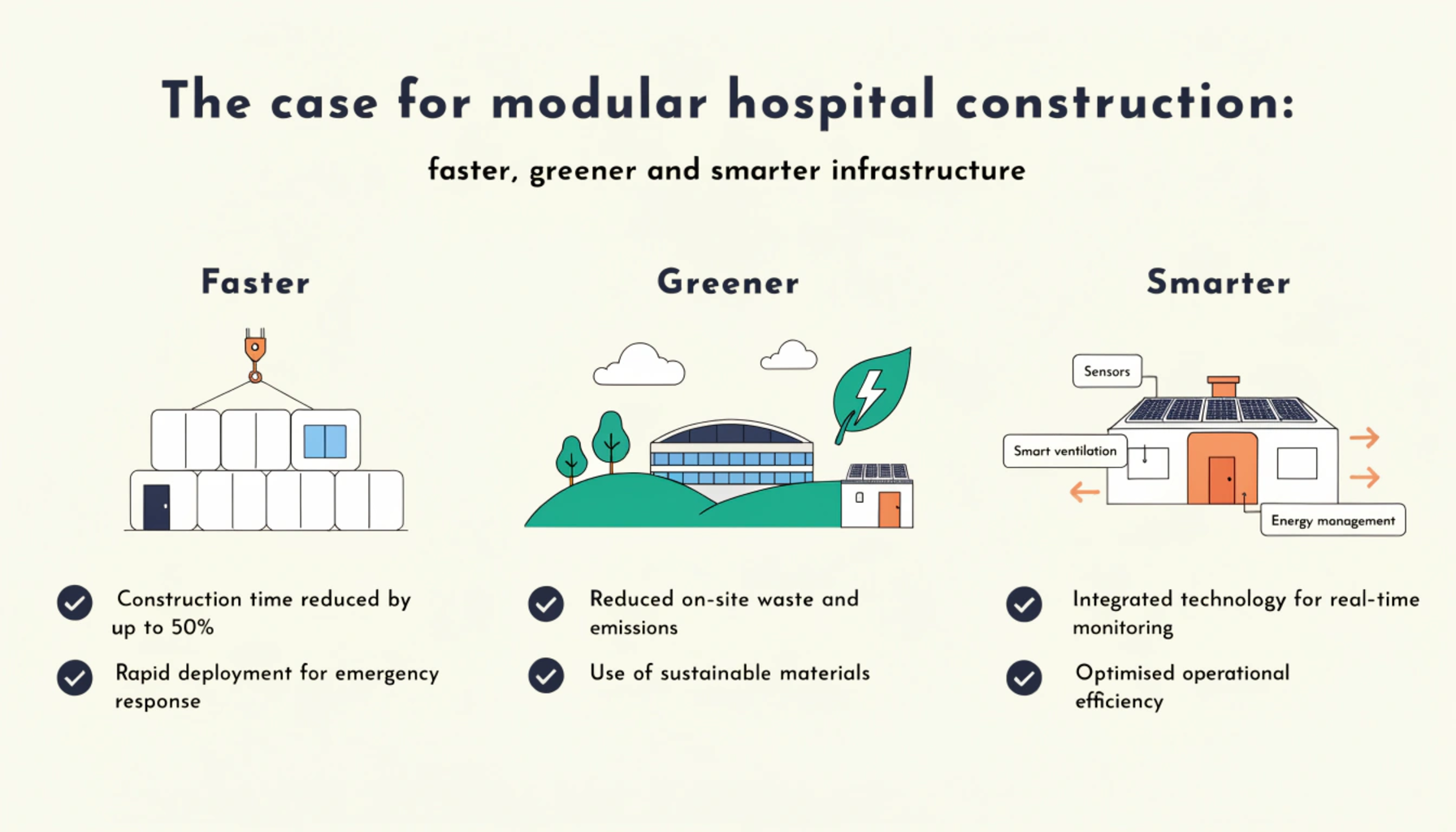
The global healthcare landscape is confronting a complex convergence of challenges: aging populations, volatile climate risks, rapid urban expansion, and an imperative to modernize legacy infrastructure without disrupting continuous patient care. Traditional brick-and-mortar hospital construction, historically characterized by multi-year schedules, costly budget overruns, and heavy environmental degradation, is rapidly becoming unviable for modern healthcare delivery. In response to these pressing pressures, modern facility leaders and clinical executives are embracing a fundamental paradigm shift toward off-site prefabrication.
As we look toward modular hospital construction 2026, off-site manufacturing is no longer viewed merely as a temporary workaround or a niche alternative for emergency expansions. Instead, it has established itself as a premier, permanent construction methodology capable of delivering sophisticated, acute-care environments. By combining advanced industrial engineering, digital twin modeling, and sustainable material science, modern prefab healthcare facilities offer an unprecedented blend of speed, environmental responsibility, and technological intelligence.
Speed to Market: Overcoming Capacity Bottlenecks and Delays
The standard timeline for constructing a traditional healthcare facility often spans five to seven years from initial site master planning to clinical commissioning. During this extended timeframe, population demographics shift, medical technologies evolve beyond their original specifications, and community healthcare demands frequently outpace existing physical capacity. Ground-up builds are perpetually vulnerable to weather disruptions, localized labor shortages, supply chain bottlenecks, and the inherent friction of coordinating dozens of subcontracted trades on an active construction site.
Modular construction bypasses these traditional bottlenecks through parallel processing. While site clearance, excavation, and foundation engineering occur on location, volumetric building modules are simultaneously engineered, constructed, and outfitted within a climate-controlled factory setting. Tradespeople, including electricians, plumbers, HVAC technicians, and drywall installers, work in optimized factory conditions under standardized quality assurance protocols.
This concurrent workflow reduces total project schedules by forty to sixty percent. Clinical wings, specialized outpatient centers, and ambulatory surgical suites that once required three years of site work can now achieve operational readiness in under twelve months. Rapid completion dramatically decreases carrying costs and capitalized interest during construction while accelerating the time to revenue for health systems. More importantly, it allows healthcare networks to respond dynamically to sudden demand spikes, localized demographic surges, and urgent clinical needs without locking capital into protracted construction cycles.
Greener Infrastructure: Eliminating Construction Waste and Lowering Carbon Footprints
The traditional construction sector remains one of the largest global contributors to landfill waste, carbon emissions, and environmental disruption. Standard on-site healthcare construction generates massive volumes of excess materials, ranging from concrete overspray and cut drywall to discarded timber framing and packaging. Furthermore, the constant transport of raw materials, heavy machinery, and commuting trade crews to an active job site generates substantial urban carbon emissions, noise pollution, and dust contamination a particularly hazardous condition when building adjacent to operational clinical spaces.
Factory-manufactured prefab healthcare facilities fundamentally rewrite this environmental equation. Operating within controlled manufacturing hubs allows industrial builders to order raw materials to precise digital specifications, virtually eliminating material scrap. Factory waste recycling programs further capture and repurpose residual steel, aluminum, and insulation, yielding up to a ninety percent reduction in total construction waste compared to conventional methodologies.
From an operational sustainability perspective, factory-built volumetric units achieve far tighter building envelope tolerances than traditional stick-built structures. Precise robotic cutting, seamless joint sealing, and automated insulation installation eliminate thermal bridging and air leakage. When these modules are assembled on-site, the resulting facility requires significantly less thermal energy for heating and cooling. Modern modular designs seamlessly incorporate recycled structural steel, low-VOC interior finishes, high-efficiency mechanical systems, and solar-ready roofing structures. As health systems across the globe work toward net-zero targets and stringent carbon compliance, adopting modular hospital construction 2026 standards offers a direct and measurable pathway to reducing both embodied and operational carbon.
| Infrastructure Dimension | Traditional Hospital Construction | Modular & Prefab Healthcare Facilities |
|---|---|---|
| Average Project Duration | 4 to 7 Years | 1 to 2 Years |
| On-Site Material Waste | High (10%–15% of materials discarded) | Low (Up to 90% waste reduction in factory) |
| Quality Control & Testing | Field inspections subject to weather/site variations | Factory-standardized quality control & digital twins |
| Operational Disruption | Severe noise, dust, and localized traffic delays | Minimal site impact; quiet and clean assembly |
| Future Expansion Flexibility | Complex, costly structural renovations | Plug-and-play vertical or lateral modular additions |
Smarter Infrastructure: Factory-Integrated Technology and Adaptive Architecture
A modern hospital is fundamentally an integrated technological ecosystem. High-performance facility management requires pervasive digital connectivity, real-time spatial awareness, sophisticated infection control systems, and robust critical power redundancies. Retrofitting legacy structures or even conventional new builds with advanced smart technologies often involves invasive wall cuts, complex conduit rerouting, and late-stage engineering changes that drive up costs.
In the era of modular hospital construction 2026, smart technology is embedded directly into the structural DNA of the building during factory fabrication. Pre-engineered wall panels and ceiling cassettes arrive on-site fully equipped with integrated IoT sensors, fiber-optic pathways, automated airflow balancing valves, and environmental monitoring systems. Automated infrastructure components such as smart HVAC dampers designed to maintain negative pressure isolation are installed, wired, and bench-tested before leaving the factory floor.
Furthermore, modular architecture provides healthcare facilities with unprecedented spatial flexibility. Clinical requirements change rapidly over a building’s fifty-year lifecycle; a space designed today for administrative offices may need to transition into an infusion center or step-down clinical unit a decade later. Prefabricated structures utilize standardized, structural grid systems and accessible MEP (mechanical, electrical, plumbing) chases that allow interior spaces to be reconfigured with minimal disruption. Rather than demolishing concrete walls and interrupting adjacent patient wards, facility managers can reconfigure modular interior layouts, replace wall cassettes, or expand laterally by connecting new factory-built modules to existing structures.
Mitigating Risk and Standardizing Clinical Excellence
For hospital administrators and facility managers, risk mitigation extends beyond financial management to encompass patient safety, acoustics, infection prevention, and regulatory compliance. On-site construction environments present constant airborne dust, acoustic disruption, and vibration risks that can jeopardize patient recovery and compromise sensitive diagnostic equipment in nearby facility wings. Modular assembly dramatically compresses the duration of on-site work, reducing site disruption from years to a matter of weeks.
Inside the factory, standardization elevates build quality to medical-grade tolerances. Every wall panel, isolation room, and surgical ceiling grid is manufactured under strict ISO quality control standards, far removed from weather hazards like rain, extreme temperatures, or high humidity that frequently degrade building materials during conventional site work. Standardization across multi-site health systems ensures that clinical staff encounter uniform room layouts, standardized headwall equipment placements, and intuitive supply access points regardless of which network facility they operate in. This spatial consistency minimizes human error, streamlines staff onboarding, and optimizes clinical workflows.
Strategic Outlook: Shaping the Next Generation of Healthcare Facilities
As the healthcare sector navigates high capital costs, severe labor constraints, and evolving patient care paradigms, off-site construction represents a necessary strategic shift. The convergence of building information modeling (BIM), artificial intelligence in facility design, and advanced off-site manufacturing has elevated prefabricated healthcare buildings into highly sophisticated, durable, and aesthetically stunning medical campuses.
To lead this transformation, health system executives, facility engineers, architects, and technology providers must convene to establish shared standards, explore emerging manufacturing innovations, and redesign capital deployment strategies. The transition to off-site prefabrication is not merely a change in construction technique; it is a holistic rethinking of how society plans, finances, builds, and maintains critical health infrastructure for generations to come.
To explore the leaders, technologies, and strategies driving this transformation across modern medical infrastructure, plan your participation at this year’s premier industry event.
Register as a delegate to secure your place at the Smart Healthcare Facilities Convention and join visionary voices shaping resilient, net-zero, and AI-ready healthcare environments.