Introduction: The High-Stakes Environment of Modern Healthcare Infrastructure
In a standard commercial office building, a temporary malfunction in the heating, ventilation, and air conditioning (HVAC) unit causes minor discomfort and a slight dip in employee productivity. In an acute care hospital, however, an unexpected fluctuation in air pressure, humidity, or temperature can halt surgical procedures, compromise sterile isolation environments, damage delicate biopharmaceuticals, and put fragile patient lives at risk. Hospitals operate as continuous, 24/7 high-stakes ecosystems where technical performance directly intersects with clinical outcomes.
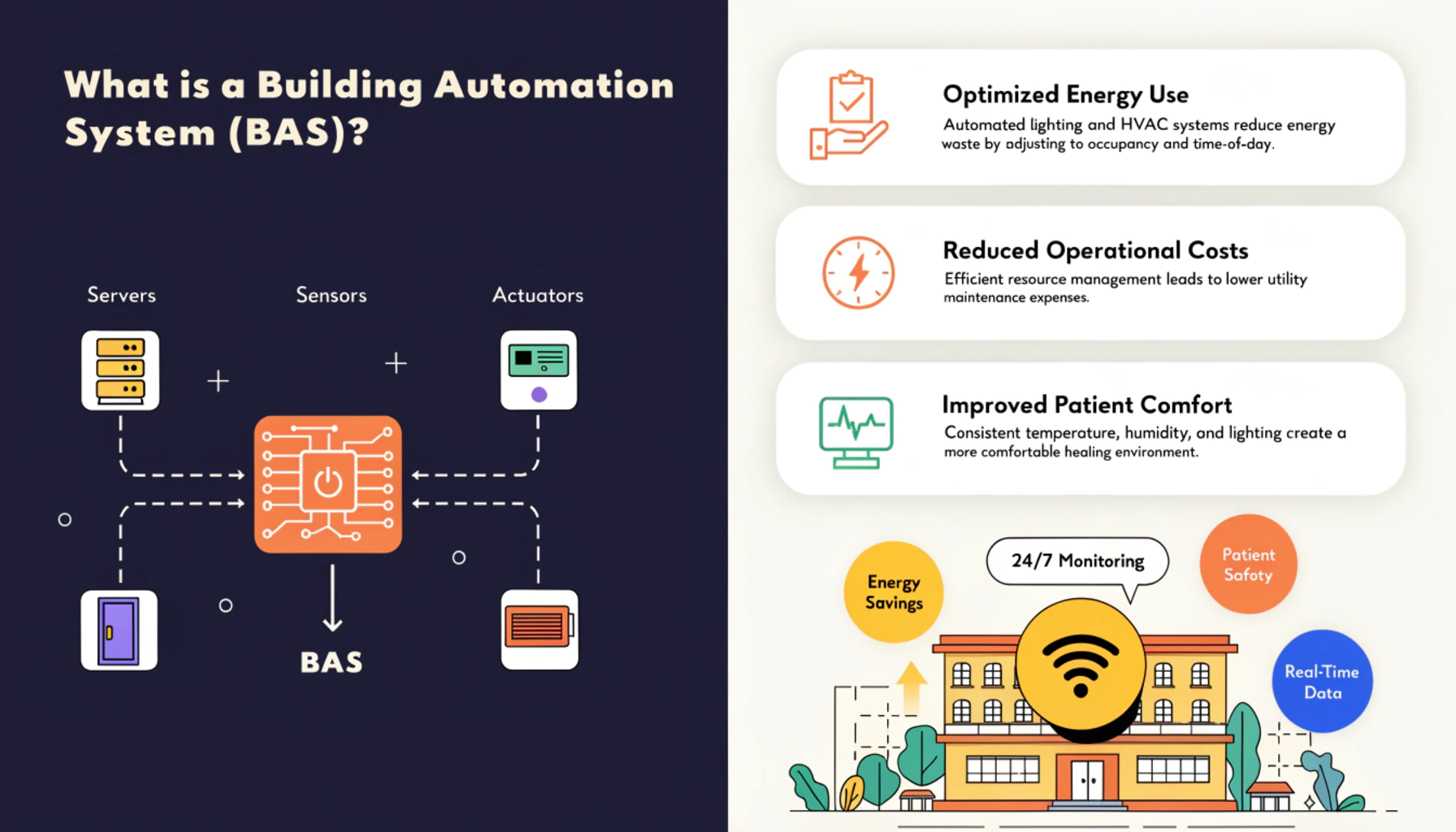
To manage this immense operational complexity, modern health systems rely on a centralized digital nervous system: the Building Automation System (BAS). A robust building automation system hospital deployment connects critical physical infrastructure, including air handlers, chillers, boilers, emergency power grids, lighting, and environmental sensors, into a unified, intelligent control platform. Rather than managing isolated mechanical components through manual checks, facility engineers gain real-time visibility and automated control over the entire physical environment.
As healthcare facilities face rising operating costs, stringent infection control mandates, carbon reduction goals, and skilled labor shortages, the role of automation has shifted from basic environmental management to strategic operational intelligence. Moving deeper into the landscape of hospital BAS 2026 standards, integrated automation is no longer a luxury feature for flagship facilities; it is the foundational infrastructure required to deliver safe, resilient, and cost-effective patient care across modern health networks.
Understanding the Core Architecture of a Healthcare BAS
At its fundamental level, a building automation system is an integrated network of hardware and software designed to monitor, control, and optimize mechanical, electrical, and plumbing systems. In a hospital environment, the BAS functions as a multi-layered architecture consisting of field sensors, direct digital controllers (DDC), communications protocols, and a centralized supervisory user interface.
Field sensors sit on the front lines, continuously measuring environmental parameters such as static duct pressure, relative humidity, room air exchange rates, carbon dioxide levels, water flow temperatures, and electrical power quality. These sensors feed data directly to specialized microprocessors known as controllers. The controllers execute pre-programmed algorithms to make split-second operational adjustments—for instance, adjusting an actuator valve to modify chilled water flow or speeding up a variable frequency drive (VFD) on a supply fan to maintain precise room pressurization.
What distinguishes healthcare building automation from traditional commercial solutions is the strict requirement for high availability, fault tolerance, and deterministic performance. Modern systems utilize open communication standards like BACnet and Modbus, enabling seamless interoperability between specialized equipment from multiple manufacturers. Centralized supervisory software compiles millions of daily data points into intuitive dashboard interfaces, giving facility leadership centralized control over distributed medical campuses and off-site ambulatory clinics.
As health systems evolve toward the hospital BAS 2026 blueprint, this basic control framework is rapidly incorporating edge computing and operational artificial intelligence. By executing analytical algorithms directly at the controller level, modern healthcare facilities can make dynamic real-time adjustments without relying solely on cloud connections or delayed manual interventions, ensuring continuous climate control even during network disruptions.
Critical Impact Areas: How a BAS Transforms Hospital Operations
1. Infection Control, Air Quality, and Clinical Safety
Infection prevention represents one of the most critical responsibilities for any hospital operations team. Airborne pathogens, mold spores, and surgical site contamination present ongoing threats to patient health. A sophisticated building automation system hospital strategy forms the first defense against healthcare-associated infections (HAIs) by enforcing precise environmental micro-climates across diverse clinical spaces.
Operating rooms require positive pressure differentials relative to adjoining corridors to prevent unfiltered air, dust, and pathogens from entering the sterile surgical field. Conversely, airborne infection isolation rooms (AIIR) require continuous negative pressure to contain infectious diseases, such as tuberculosis or viral respiratory infections, preventing harmful microbes from escaping into general care areas. A specialized BAS continuously monitors differential pressure sensors and modulates supply and exhaust air volumes in real time to guarantee that these pressure boundaries remain intact.
Relative humidity control is equally vital. Excess humidity creates breeding conditions for bacteria and mold while degrading sterile supply packaging. Excessively dry air irritates mucosal membranes in patients and increases the survival time of aerosolized viral particles. A dedicated BAS actively balances humidifiers, cooling coils, and reheat systems to keep indoor relative humidity strictly within the clinically recommended 30% to 60% window. Automated compliance logging continuously records these parameters, providing verifiable audit trails for accreditation inspections by the Joint Commission and public health agencies.
2. Transitioning to Predictive Maintenance and Automated Diagnostics
Traditional hospital maintenance models heavily relied on reactive repairs fixing critical components only after they failed or rigid calendar-based maintenance schedules that frequently consumed valuable labor resources on perfectly functional equipment. A modern building automation system hospital environment transforms this approach by introducing Automated Fault Detection and Diagnostics (FDD) integrated with Computerized Maintenance Management Systems (CMMS).
By analyzing continuous sensor streams against expected performance curves, the system detects subtle anomalies long before a mechanical breakdown occurs. For example, if an air handling unit’s cooling coil valve demonstrates a 15% drop in heat transfer efficiency, or if a primary chilled water pump exhibits micro-vibrations indicative of bearing wear, the BAS automatically identifies the fault, diagnoses the underlying root cause, and generates a prioritized work order in the facility team’s CMMS platform.
This shift from reactive firefighting to data-driven predictive maintenance generates substantial operational benefits. Unplanned equipment downtime across critical care suites can be reduced by 50% to 60%, extended asset life cycles delay capital expenditure costs, and specialized engineering staff can focus their attention on targeted repairs rather than routine physical inspections.
3. Energy Efficiency, Microgrid Integration, and Net-Zero Goals
Hospitals are among the most energy-intensive commercial structures in existence. Operating continuously 24 hours a day, 365 days a year, medical facilities require heavy heating and cooling loads, high air exchange rates, and massive electricity supplies to power life-support systems and advanced imaging technology. Consequently, utility expenses constitute a major line item in healthcare operating budgets.
Implementing an intelligent BAS gives hospital facility managers the precise tools needed to drive down energy consumption without risking clinical safety or patient comfort. Advanced control strategies like dynamic temperature setback schedules automatically drop air exchange rates and modify cooling setpoints in non-clinical administrative areas, outpatient clinics, and unoccupied surgical suites during off-peak night hours. Dynamic reset algorithms adjust supply air temperatures and duct static pressure based on real-time zone demand rather than worst-case design assumptions.
Furthermore, forward-looking strategies embedded in the hospital BAS 2026 paradigm focus heavily on deep decarbonization and grid interactivity. Modern systems orchestrate complex microgrid infrastructure, balancing draw between municipal electrical grids, on-site solar arrays, battery energy storage systems (BESS), and combined heat and power (CHP) units. By automatically shedding non-essential electrical loads during peak tariff pricing periods and storing thermal energy overnight, health systems can achieve measurable carbon reductions while significantly reducing annual utility costs.
| Operational Area | Legacy / Manual Management | Modern Hospital BAS Capabilities | Impact on Hospital Operations |
|---|---|---|---|
| Infection Control | Periodic manual pressure checks with physical gauges | Continuous automated pressure, air exchange, and humidity balancing | Reduces HAIs, protects sterile zones, automates compliance reporting |
| Maintenance Strategy | Reactive repairs after component breakdown; fixed calendar cycles | Automated Fault Detection & Diagnostics (FDD) with CMMS integration | Decreases unplanned downtime by 50–60%, extends asset lifespans |
| Energy Management | Static 24/7 maximum output across all facility zones | Dynamic demand-controlled ventilation, load shedding, and microgrid orchestration | Lowers utility costs, reduces carbon emissions, supports net-zero targets |
| Emergency Response | Manual switchovers and manual physical checks during disruptions | Automated failover, backup generator sequencing, and real-time load management | Ensures continuous power and environmental stability during disasters |
4. Convergence of Operational Technology (OT) and Information Technology (IT)
Historically, hospital building management operated in an isolated silod realm, completely detached from main enterprise IT networks and medical equipment systems. Modern facility management demands complete convergence between Operational Technology (OT) and Information Technology (IT), creating a unified operational architecture.
When a building automation system hospital network communicates with real-time location systems (RTLS), electronic health records (EHR), and admissions platforms, powerful operational synergies emerge. For instance, when an operating room schedule indicates a surgical delay, the BAS can adjust climate controls in that specific room to a standby energy-saving state, rapidly returning to precise sterile conditions fifteen minutes before the patient arrives. Similarly, room environment preferences can be synchronized with patient admission systems, tailoring room light and temperature to individual patient comfort care plans automatically.
However, this increased digital connectivity also expands the potential cyber-attack surface across physical building systems. Modern BAS implementations incorporate enterprise-grade cybersecurity standards, including end-to-end data encryption, multi-factor authentication, network micro-segmentation, zero-trust architecture, and SOC 2 compliance. These safeguards ensure that critical building infrastructure remains protected against malicious intrusion, physical manipulation, and ransomware threats.
5. Disaster Preparedness and Climate Resilience
Severe weather events, regional power grid failures, and unexpected public health emergencies present unprecedented stress tests for healthcare infrastructure. During an external emergency, a hospital must maintain uninterrupted critical operations while managing sudden surges in patient volume.
An advanced BAS serves as the backbone for facility resilience. In the event of a main utility grid blackout, the automation platform coordinates the seamless transition to backup generators, uninterruptible power supplies (UPS), and emergency microgrids, prioritizing life-safety circuits and critical ICU equipment within seconds. If floodwaters or extreme temperatures threaten external utilities, the system dynamically isolates affected building zones, re-routes chilled water, and adjusts ventilation loops to protect core patient care areas.
During infectious disease outbreaks requiring rapid surge capacity, facility teams can utilize modern BAS software to instantly convert standard medical-surgical patient wings into temporary negative-pressure isolation wards at the touch of a button. This level of agility transforms rigid brick-and-mortar facilities into flexible, highly adaptable care environments capable of responding effectively to modern crises. +—————————————+
| Centralized BAS Master Software |
| (Analytics, Dashboards & Control) |
+——————-+——————-+
|
+—————————-+—————————-+
| | |
+———–v———–+ +———–v———–+ +———–v———–+
| Infection & Climate | | Maintenance & Assets | | Energy & Resiliency |
| – Pressure Control | | – Automated FDD | | – Microgrid Control |
| – HEPA & Humidity | | – CMMS Work Orders | | – Load Shedding |
| – Dynamic Setbacks | | – Asset Longevity | | – Failover Systems |
+———————–+ +———————–+ +———————–+
Preparing Healthcare Infrastructure for 2026 and Beyond
As healthcare delivery continues to decentralize across ambulatory networks, outpatient surgical hubs, and micro-hospitals, maintaining consistent facility standards becomes increasingly complex. Managing distributed health system footprints requires a transition toward enterprise-level, multi-site automation strategies.
In the evolving ecosystem of hospital BAS 2026, facility leaders are moving away from managing isolated building systems toward deploying unified, enterprise-wide operational engines. Cloud-based supervisory platforms gather data from dozens of regional care sites into a single operational interface. This central visibility allows health systems to benchmark energy usage across properties, standardize preventive maintenance protocols, optimize specialized technician schedules, and enforce uniform infection control protocols across an entire healthcare system.
Furthermore, as artificial intelligence tools mature, the next generation of building automation will move beyond pre-programmed control rules toward true self-learning autonomy. Machine learning algorithms will analyze local weather forecasts, utility grid pricing shifts, facility occupancy patterns, and historical clinical load data to proactively predict building needs hours in advance. By pre-cooling spaces during low-cost night hours or preemptively adjusting air exchange rates ahead of expected clinical surges, autonomous systems will optimize energy usage and indoor environments with minimal manual oversight.
Elevating Hospital Operations Through Intelligent Automation
A modern building automation system is far more than a digital thermostat for complex mechanical infrastructure; it is a critical operational driver that directly impacts patient outcomes, environmental safety, utility expenditure, and facility resilience. By replacing manual interventions and reactive maintenance with real-time data feeds, automated control loops, and predictive analytics, a well-implemented building automation system hospital infrastructure turns physical facilities into strategic assets.
As health systems prepare for future operational challenges, investing in open, intelligent, and secure automation architecture will be essential for delivering efficient, sustainable, and high-quality care across every level of the health system.
Want to explore the latest ideas shaping smart healthcare facilities and modern hospital operations?
Explore convention topics: Smart Healthcare Facilities Convention