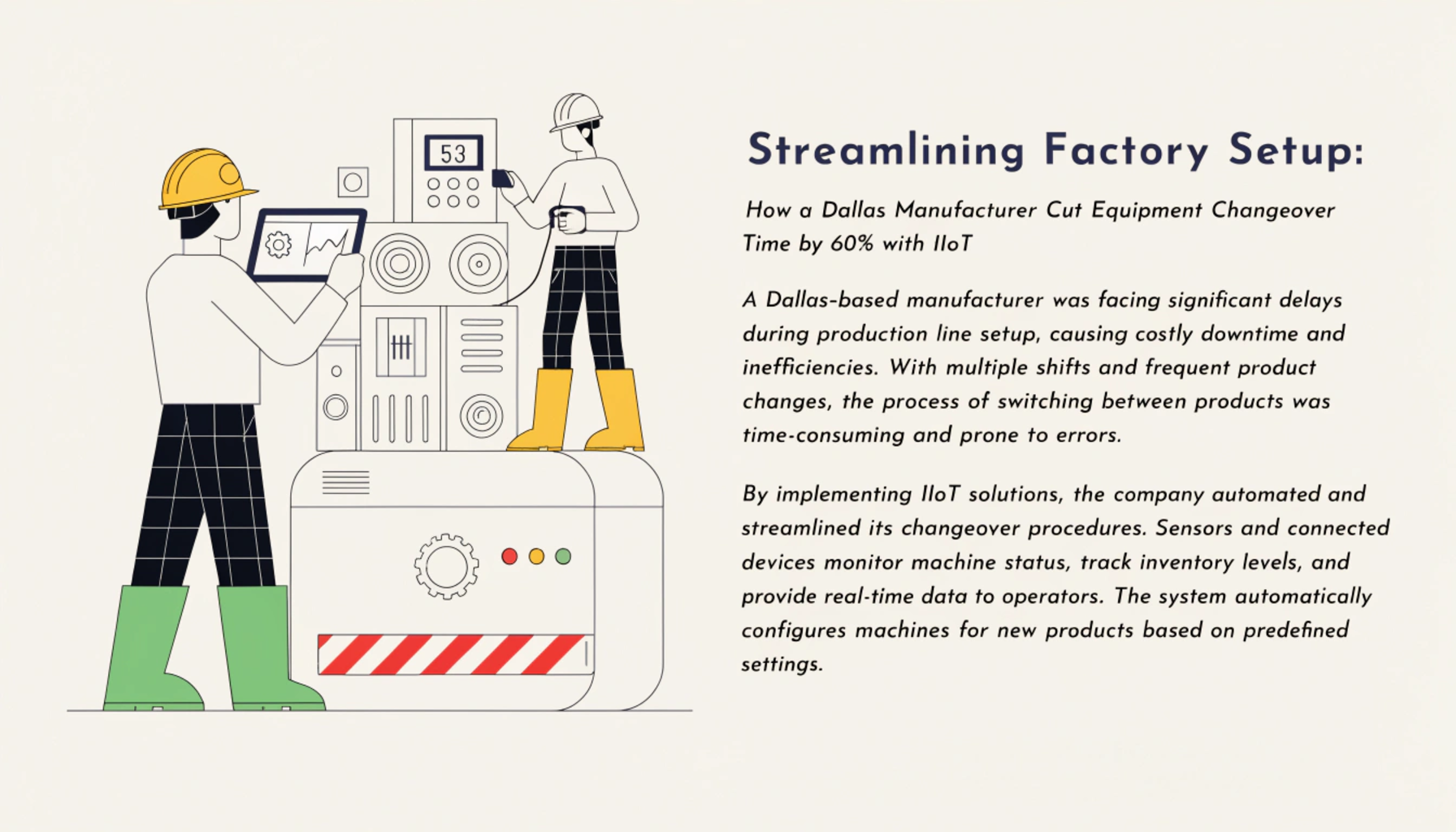
In high-mix industrial manufacturing, production agility is directly tied to plant profitability. As customer specifications become increasingly customized and batch sizes shrink, facility directors and plant operations managers face an ongoing dilemma: how to accommodate rapid product changeovers without sacrificing Overall Equipment Effectiveness (OEE) or inflating operational costs.
Every hour a production line sits idle for tooling changeouts, die exchanges, or manual calibration represents lost capacity, unrecoverable labor expense, and potential delivery delays. While traditional Lean methodologies like Single-Minute Exchange of Die (SMED) offer a proven physical baseline, physical organization alone reaches a ceiling when setup verification remains manual and disconnected from plant data systems.
A precision metal fabrication and stamping plant in Dallas, Texas, recently overcame this barrier by pairing Lean practices with the Industrial Internet of Things (IIoT). By deploying smart tooling, connected sensors, and automated parameter recipes, the facility achieved an impressive 60% reduction in equipment changeover times, slashing setup durations from nearly two hours to under 45 minutes.
This industrial IoT case study USA explores how targeted IIoT manufacturing Dallas implementations can modernize brownfield machinery, eliminate setup scrap, and unlock hidden factory floor capacity.
The Setup Dilemma: Why Manual SMED Hits a Ceiling
Line changeovers in discrete manufacturing have historically relied on mechanical adjustments, visual inspections, and manual parameter entry. While the manufacturer had already implemented foundational Lean SMED principles such as organizing tooling carts, standardizing fastener sizes, and staging upcoming dies outside the work cell unplanned delays persisted.
The operations team identified several systemic bottlenecks inherent to manual setups:
- Manual Configuration Errors: Technicians manually referenced paper binders or disconnected terminal screens to set stroke heights, press tonnage, hydraulic pressures, and feeder pitches. A single keystroke error could cause severe die damage or line tripping.
- Protracted Quality Sign-Offs: After completing physical mechanical swaps, operators had to run test parts and walk them to an off-line quality lab for CMM inspection. Machinery sat idle for 30 to 45 minutes waiting for quality sign-off.
- Skill-Level Variance: Setup efficiency varied drastically between veteran toolmakers and junior operators. Inconsistent manual torque application and mechanical alignment resulted in unpredictable setup durations.
- Thermal Expansion Drift: Heavy stamping presses generate significant mechanical heat during sustained operations. Pre-setting tooling without real-time thermal compensation frequently resulted in dimensional drift during the first hour of production, generating unacceptable scrap rates.
Recognizing that physical adjustments had been streamlined as much as possible, plant leadership turned to digital automation to eliminate information lag and human verification bottlenecks.
Engineering the IIoT Architecture for Brownfield Facilities
Rather than undertaking a multi-million-dollar replacement of existing stamping presses and CNC press brakes, the engineering team implemented a non-invasive IIoT retrofit architecture designed for rapid integration with legacy assets.
The technical framework centered on four core elements:
1. RFID-Tagged Tooling and Automated Verification
Every die set, stamping punch, and clamping fixture was equipped with industrial passive RFID tags. RFID antennas installed at press entry gates automatically read incoming tooling, instantly verifying that the operator selected the correct die set for the scheduled production run before mechanical mounting began.
2. Multi-Sensor Operational Telemetry
Non-intrusive sensor arrays were mounted across critical mechanical points:
- Laser Displacement Sensors: Measured shut height and die positioning down to the micron, eliminating manual caliper checks and dial indicator setups.
- Thermal Sensors: Monitored press frame, bearing, and hydraulic oil temperatures, enabling the control system to calculate and compensate for thermal expansion automatically.
- Hydraulic Pressure Transducers: Verified instantaneous clamping force across all tie-rods, ensuring uniform pressure distribution and preventing premature tool wear.
3. Industrial Edge Gateways and Open Protocols
Plant floor edge gateways connected directly to legacy PLCs using open communication standards (OPC UA and MQTT). Edge gateways processed raw high-frequency sensor signals locally, filtering background plant noise and transmitting validated recipe parameters directly into machine registers in milliseconds.
4. Interactive Digital Work Instructions
Paper checklists were replaced by ruggedized touch-screen terminals mounted at each work cell. The digital system guided technicians through step-by-step setup sequences, using sensor feedback to validate each step before allowing the operator to proceed.
Inside the Digital Changeover Workflow
By digitizing setup verification, the plant transformed what had been an uncoordinated manual procedure into a streamlined, automated workflow.
1. Automated Material Staging
Thirty minutes before a run finishes, the plant’s MES signals warehouse systems and automated guided vehicles (AGVs). The upcoming raw coil stock, secondary hardware, and verified RFID die set are delivered directly to the work cell, eliminating operator transit time.
2. Instantaneous One-Touch Recipe Loading
When the previous job ends, the operator scans the job barcode. The IIoT platform cross-checks the physical RFID tag on the staged die with the ERP schedule. Once validated, the edge gateway transmits all press parameters shut height, counterbalance pressure, feed rate, and lubrication volumes—directly into the PLC. A configuration process that previously required 15 to 20 minutes of manual adjustment now takes under 10 seconds.
3. Laser-Guided Alignment and Power Clamping
The operator positions the tooling using visual laser guides that indicate precise physical alignment. Once in place, automated pneumatic-hydraulic clamps engage, with pressure transducers confirming uniform clamping force across all mounting points.
4. In-Line High-Speed First-Article Inspection
To eliminate the 40-minute quality lab bottleneck, the plant installed high-resolution optical profile scanners at the press outfeed. The first part stamped is scanned continuously as it exits the die, with dimensional data compared in real time against CAD nominals. If the part meets tolerance, the system flashes a green indicator and releases the line for full-speed production in under 60 seconds.
Measurable Operational ROI and Business Impact
Within nine months of deploying the IIoT changeover system across its primary press lines, the manufacturer documented dramatic operational gains:
| Operational Metric | Before IIoT Deployment | After IIoT Implementation | Improvement |
|---|---|---|---|
| Average Setup & Changeover Time | 110 minutes | 44 minutes | 60% reduction in setup duration |
| Quality Lab Sign-Off Wait Time | 38 minutes | Under 2 minutes | 95% faster first-article approval |
| Post-Setup Scrap Volume | 4.8% of run | 1.1% of run | 77% decrease in scrap waste |
| Overall Equipment Effectiveness (OEE) | 62.4% | 78.6% | 16.2 percentage point increase |
| Annual Machine Run-Time Gained | Baseline | +220 hours / machine | Equivalent to adding a new production line |
By recovering more than 200 hours of productive run-time per press annually, the plant absorbed substantial new customer contracts without expanding physical floor space or purchasing additional capital machinery.
Furthermore, reducing changeovers to under 45 minutes enabled the facility to cut minimum batch sizes in half, significantly reducing warehouse inventory holding costs and accelerating order delivery timelines.
Workforce Adoption and Frontline Engagement
Operational technology upgrades succeed only when plant floor teams embrace the tools. Leadership prioritized technician involvement from the initial design phase:
- Ergonomic Improvement: Automating heavy clamping and eliminating manual wrenching reduced physical strain and workplace ergonomic injuries.
- Empowering Less Experienced Operators: Interactive visual tablets enabled junior technicians to execute complex setups with the accuracy and speed of veteran toolmakers, shortening training cycles by 50%.
- Shift Collaboration: Real-time cell dashboards displayed setup countdown timers, creating shared visibility and recognizing teams that achieved smooth, safe changeovers.
Key Takeaways for Industrial Plant Managers
For facility directors and plant operations leaders seeking to modernize factory operations in 2026 and 2027, this case study provides clear guidance:
- Build on Lean Fundamentals First: Ensure physical tooling carts, 5S workspace cleanliness, and pre-staging routines are established before installing digital systems. Technology amplifies good processes; it cannot correct physical disorganization.
- Leverage Brownfield Retrofits: High-value industrial machinery rarely needs total replacement. Adding non-invasive sensors and edge gateways provides rapid ROI at a fraction of capital replacement costs.
- Eliminate Off-Line Quality Delays: Waiting for quality lab sign-offs is often the largest single source of setup downtime. In-line optical gauging or machine-adjacent inspection delivers immediate throughput gains.
- Keep User Interfaces Simple: Frontline tools must be intuitive, visual, and ruggedized for harsh industrial environments.
Conclusion: Building an Agile, Future-Ready Plant
The success of this Dallas manufacturing facility proves that digital modernization delivers immediate, bottom-line returns when applied to specific shop-floor bottlenecks. By integrating IIoT manufacturing Dallas capabilities with proven operational methodologies, industrial facilities can eliminate changeover friction, protect operating margins, and achieve world-class production agility.
As manufacturing demands continue to trend toward smaller batches and tighter turnaround times, facilities that connect physical machinery with real-time operational data will set the benchmark for industrial excellence.
Looking to modernize your manufacturing facility, optimize plant floor operations, and connect with industry automation pioneers?
Explore Smart Manufacturing & Plant Modernization Solutions and discover actionable blueprints to upgrade your factory with IIoT, predictive maintenance, and intelligent operations.