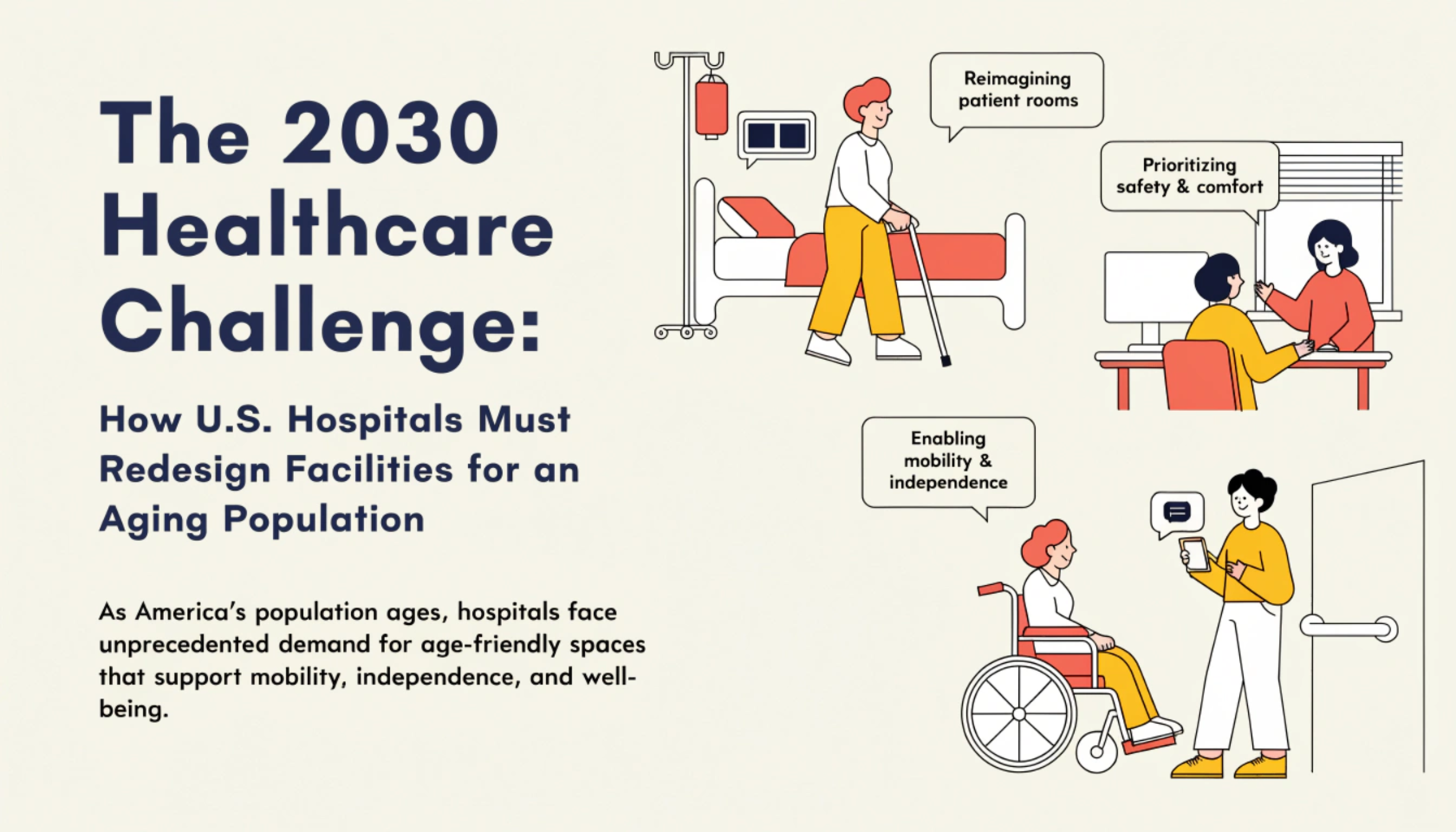
The U.S. healthcare system is approaching a major demographic turning point. By 2030, the entire Baby Boomer generation will have reached age 65 or older, creating a significant increase in demand for healthcare services. Recent analysis has described 2030 as an important inflection point for U.S. hospitals, as an aging population converges with workforce shortages, financial pressure and rapidly evolving technology. (Axios)
This shift means hospitals cannot simply add more beds or expand existing buildings. They need to rethink how facilities are planned, designed and operated.
The future of hospital facility planning 2030 will increasingly focus on accessibility, flexibility, patient safety, technology integration, staff efficiency and environments that support older adults with complex and chronic conditions.
Why 2030 Will Be a Turning Point for U.S. Hospitals
America’s aging population is already influencing healthcare demand. According to the U.S. Department of Health and Human Services, people aged 65 and older represented 17% of the U.S. population in 2020, and that share is expected to reach 22% by 2040. The agency also notes that an aging population creates greater demand for healthcare services as well as family and professional caregivers. (Health Promotion Office)
The demographic shift is particularly important because older patients often require more complex and frequent care. Multiple chronic conditions, mobility limitations, cognitive impairment and longer recovery periods can make conventional hospital environments less suitable.
At the same time, hospitals are dealing with workforce shortages and financial constraints. A recent 2026 healthcare outlook from McKinsey highlights continuing pressure from healthcare costs, changing demand and operational challenges across the U.S. system. (McKinsey & Company)
This combination creates a clear challenge: how can hospitals care for more older patients without simply increasing pressure on already stretched facilities and staff?
The answer begins with the physical environment.
Designing Hospitals Around the Needs of Older Adults
Traditional hospital design often prioritizes clinical efficiency. But aging patients require a broader approach that considers mobility, sensory needs, cognitive comfort and independence.
For example, long corridors, confusing layouts, slippery surfaces, poor lighting and difficult-to-find departments can create unnecessary risks for older adults. Future facilities should make navigation easier through intuitive layouts, highly visible signage, appropriate lighting and shorter travel distances.
Bathrooms and patient rooms will also require greater attention to accessibility. Wider circulation areas, appropriately positioned handrails, non-slip flooring, accessible bathrooms and furniture designed for different mobility levels can help reduce falls and support independence.
These changes should not be treated as special features for a small group of patients. As the population ages, age-friendly design will increasingly become standard healthcare design.
Hospital Facility Planning 2030 Must Prioritize Flexibility
One of the biggest lessons for hospital facility planning 2030 is that healthcare buildings must be adaptable.
Medical technology, treatment models and patient demographics can change considerably over the lifetime of a hospital. A building designed only for today’s needs can become inefficient or expensive to modify.
Flexible infrastructure can allow spaces to be converted as demand changes. Patient rooms, diagnostic areas, treatment spaces and support areas can be designed with adaptable layouts, accessible utilities and infrastructure that can accommodate future technologies.
This approach is becoming increasingly important as healthcare moves between inpatient, outpatient, virtual and community-based models.
Recent healthcare design discussions have emphasized master planning, adaptable environments and patient-centered spaces that can respond to changing care models. (Wold Architects & Engineers)
For hospital leaders, the objective should not simply be to construct a larger building. It should be to construct a building that can change with healthcare.
Creating Safer Patient Rooms
Patient rooms will become another important area of innovation.
Older adults can be particularly sensitive to environmental factors such as noise, lighting and disruptions during the night. Poor sleep can affect recovery, comfort and overall patient experience.
Recent reporting from the San Francisco Bay Area shows hospitals experimenting with designs intended to improve patient sleep. Sutter Health, Kaiser Permanente and UCSF are exploring features including private rooms, reduced nighttime lighting, sound-absorbing materials, redesigned alarms and technology that supports circadian rhythms. (San Francisco Chronicle)
These developments demonstrate how seemingly small design decisions can influence the patient experience.
For older patients, future rooms may increasingly incorporate:
- Better nighttime lighting and circadian-friendly controls
- Reduced noise from corridors and equipment
- Easier access to bathrooms
- Fall-prevention features
- Clear views of doors and surroundings
- Comfortable spaces for family caregivers
- Smart monitoring systems
- Adjustable furniture and patient beds
The goal is to create rooms that support healing while reducing unnecessary physical and cognitive stress.
Aging Population Healthcare Infrastructure Must Extend Beyond the Hospital
The biggest mistake hospitals could make is designing the future around inpatient care alone.
An aging population will require a connected network of hospitals, outpatient centers, rehabilitation facilities, diagnostic services, home healthcare and community-based care.
Healthcare design trends are already moving toward more decentralized services. Community diagnostic facilities and outpatient models can bring selected services closer to where patients live, potentially reducing unnecessary hospital visits. (Health Spaces)
This has major implications for aging population healthcare infrastructure.
A patient may move through several healthcare environments during one episode of care: a primary care clinic, diagnostic center, hospital, rehabilitation facility and eventually home healthcare. These environments need to work together rather than operate as isolated buildings.
Future hospital campuses may therefore increasingly function as healthcare hubs connected to smaller community facilities and digital care platforms.
Technology Will Become Part of the Building
Technology is another major component of future healthcare facilities.
Artificial intelligence, remote monitoring, automation, digital wayfinding and connected medical devices are increasingly becoming part of healthcare operations. But technology should not simply be added to an existing building. Infrastructure should be designed to support it from the beginning.
For older patients, technology could support safer and more personalized care through fall detection, remote monitoring, medication management and automated alerts.
However, technology must remain easy to use. A complicated digital system can become another barrier for patients who have limited digital literacy, visual impairments or cognitive challenges.
The same principle applies to hospital staff. Technology should reduce administrative and repetitive work rather than create additional complexity.
This is especially important as healthcare organizations face workforce shortages. Current U.S. labor-market data shows strong employment demand in healthcare and social assistance, with aging populations contributing to rising demand for services. (MarketWatch)
The best technology-enabled facility will therefore be one that helps both patients and employees.
Designing for Family Caregivers
Older patients rarely experience healthcare alone. Family members frequently participate in transportation, communication, decision-making and post-discharge care.
Hospital design should reflect this reality.
Patient rooms can provide appropriate space for family members without compromising infection control or staff movement. Waiting areas should offer comfortable seating, charging facilities and access to information. Clear wayfinding can reduce confusion for families navigating large hospital campuses.
Including families in the design process can also improve the transition from hospital to home.
This becomes increasingly important as hospitals seek to reduce avoidable readmissions and improve continuity of care.
Sustainability and Resilience Cannot Be Ignored
Future healthcare facilities must also be prepared for environmental and operational disruption.
Extreme weather, power failures, supply-chain disruptions and other emergencies can disproportionately affect older adults and medically vulnerable populations.
Healthcare design is increasingly incorporating resilience and sustainability alongside traditional clinical requirements. In 2026, industry discussions have included all-electric hospitals and other emerging approaches to healthcare facility design. (Building Design + Construction)
For hospitals planning major projects, resilience can include backup power, redundant critical systems, efficient water management, climate-conscious building materials and infrastructure capable of maintaining essential services during emergencies.
Sustainable design can also reduce long-term operating costs, which is particularly valuable when hospitals face continuing financial pressure.
The Rise of Human-Centered Healthcare Design
Perhaps the most important change is that healthcare facility design is becoming more human-centered.
Hospitals are increasingly recognizing that the physical environment can influence stress, comfort, recovery and staff wellbeing.
Recent healthcare design work has emphasized environments that provide greater personalization, connection, flexibility and support for patients, families and care teams. (Wold Architects & Engineers)
For older adults, this could mean more access to natural light, outdoor views, quiet spaces, comfortable waiting environments and intuitive navigation.
A hospital should not feel like a maze of clinical spaces. It should help patients understand where they are, where they need to go and what is happening around them.
What Hospital Leaders Should Do Now
Preparing for 2030 does not necessarily mean every hospital needs to build a new campus.
Existing facilities can begin preparing through phased modernization.
Leaders should evaluate current buildings against future demographic needs, identify areas where older patients experience difficulty and prioritize improvements that can deliver measurable benefits.
Instead of asking only, “How many beds do we need?”, hospital planners should ask:
Can older patients navigate this facility independently?
Can the building support changing models of care?
Can staff work efficiently without unnecessary travel and administrative burden?
Can patient rooms accommodate mobility, sensory and cognitive needs?
Can the facility continue operating during disruptions?
Can today’s infrastructure support tomorrow’s technology?
These questions can help transform facility planning from a construction exercise into a long-term healthcare strategy.
Conclusion: The Hospital of 2030 Must Be Designed for Change
The aging U.S. population is not a distant challenge. It is already reshaping healthcare demand.
By 2030, demographic change, workforce pressure, financial constraints and technological transformation will make traditional hospital planning increasingly difficult. The facilities that succeed will be those designed around flexibility, accessibility, resilience and human needs.
The future of hospital facility planning 2030 is therefore not simply about constructing bigger hospitals. It is about creating smarter, safer and more adaptable healthcare environments.
At the center of this transformation is aging population healthcare infrastructure: facilities that allow older adults to receive complex care while maintaining dignity, independence and comfort.
As healthcare systems make long-term capital decisions today, the question is no longer whether hospitals need to prepare for an aging population. The question is whether they can afford not to.
Register now and connect with leaders shaping the future of healthcare facilities.