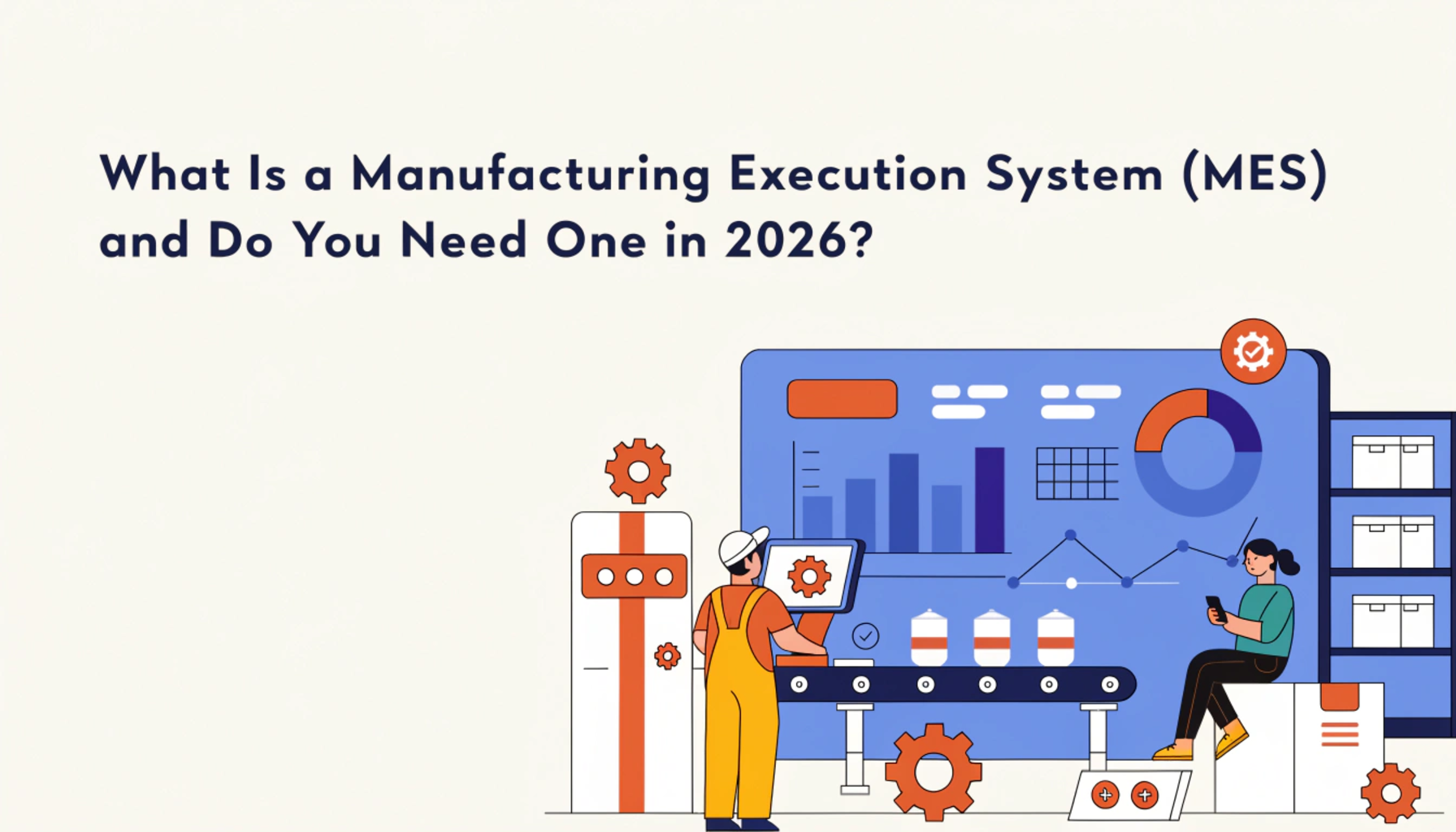
Manufacturing is becoming more connected, automated, and data-driven than ever. As manufacturers adopt industrial IoT, robotics, artificial intelligence, digital twins, and advanced analytics, the ability to manage production data in real time has become increasingly important. This is where a manufacturing execution system MES can play a critical role.
An MES connects people, machines, materials, processes, and production data to provide manufacturers with better visibility into what is happening on the factory floor. Instead of relying on spreadsheets, paper records, disconnected systems, or delayed reports, manufacturers can use MES technology to monitor production and make faster operational decisions.
But does every manufacturer need an MES in 2026? The answer depends on the size of your operation, production complexity, existing technology infrastructure, and business objectives.
What Is a Manufacturing Execution System (MES)?
A manufacturing execution system MES is software designed to monitor, manage, and optimize manufacturing operations in real time. It sits between enterprise-level business systems, such as an ERP platform, and operational technology on the factory floor, including machines, sensors, programmable logic controllers, and automation systems.
The primary purpose of MES is to provide a reliable digital connection between production planning and actual manufacturing activity.
For example, an ERP system may determine what products need to be manufactured and when they need to be delivered. An MES helps translate those plans into actionable production activities. It can track whether machines are running, whether operators have completed assigned tasks, whether materials are available, and whether products meet quality requirements.
This makes MES an important part of the modern digital factory.
Rather than simply collecting information, an MES can turn production data into actionable insights. Manufacturing leaders can use these insights to identify bottlenecks, reduce downtime, improve quality, increase productivity, and make better use of resources.
How Does an MES Work?
An MES typically collects data from multiple sources across the manufacturing environment. These may include machines, sensors, operators, production lines, quality systems, warehouse systems, and enterprise software.
The system then organizes this information into a centralized operational view.
Imagine a production line experiencing unexpected downtime. Without an MES, an operations manager might discover the problem after reviewing shift reports or production records. By that time, valuable production hours may already have been lost.
With MES technology, production teams can receive near-real-time information about machine status, downtime events, production quantities, quality issues, and work orders. This allows teams to investigate problems much sooner.
The exact capabilities vary between platforms, but modern MES solutions commonly support production tracking, scheduling, quality management, traceability, maintenance coordination, inventory visibility, performance monitoring, and electronic work instructions.
Why Is MES Becoming More Important in 2026?
Manufacturers in 2026 are facing a combination of challenges that make real-time production visibility increasingly valuable.
Labor shortages, supply chain uncertainty, increasing customer expectations, energy costs, product customization, regulatory requirements, and pressure to improve efficiency are forcing manufacturers to rethink how they manage operations.
At the same time, factories are generating more data than ever.
Connected equipment can produce information about temperature, vibration, cycle time, energy consumption, machine status, and production performance. However, collecting data is only useful if manufacturers can convert it into decisions.
This is one reason MES software 2026 strategies are increasingly focused on integration, analytics, automation, and real-time decision-making.
Manufacturers are no longer looking at MES as simply a production tracking system. Increasingly, it can become part of a broader smart manufacturing architecture.
Key Benefits of a Manufacturing Execution System MES
One of the biggest benefits of MES is improved production visibility.
Managers can gain a clearer understanding of what is happening across production lines without waiting for manually prepared reports. They can see production progress, downtime, quality information, and other operational indicators in one environment.
This visibility can help identify problems earlier.
Another important advantage is improved production efficiency. By analyzing information about machine utilization, cycle times, downtime, and production output, manufacturers can identify where capacity is being lost.
For example, if a particular machine repeatedly causes production delays, MES data can help reveal how frequently the problem occurs and how much production time is affected.
Better Quality Management
Quality management is another major application.
An MES can record information about production processes, materials, equipment, operators, inspections, and finished products. This creates greater traceability throughout the manufacturing process.
If a quality problem occurs, manufacturers can investigate which materials, machines, processes, or production batches may have contributed to the issue.
This is particularly valuable in industries where traceability and compliance are essential.
Improved Production Scheduling
Production schedules can quickly become outdated when machines experience downtime, materials arrive late, or customer requirements change.
MES platforms can provide production teams with current information about shop-floor conditions, allowing them to respond more effectively to changing circumstances.
Rather than making decisions based entirely on static schedules, managers can use current production information to prioritize work and address bottlenecks.
Reduced Manual Data Entry
Paper-based processes and spreadsheets can create errors, delays, and duplicated work.
An MES can automate the collection and recording of many production-related data points. This reduces administrative workload and allows employees to spend more time on activities that require human judgment and expertise.
MES and ERP: What’s the Difference?
One common question is whether MES replaces ERP.
In most cases, it does not.
ERP systems are generally focused on enterprise-level processes such as finance, procurement, sales, inventory, supply chain management, and business planning.
MES is more focused on manufacturing execution and shop-floor operations.
The two systems can work together.
For example, an ERP system might contain a production order for 10,000 units. The MES can receive that order and provide detailed information about how production is progressing.
The MES can then send relevant production information back to the ERP system, creating a connection between business planning and actual factory-floor performance.
This integration becomes especially important for manufacturers pursuing digital transformation.
MES and Industry 4.0
Industry 4.0 is based on connected, intelligent, and increasingly autonomous manufacturing environments. Technologies such as IoT, AI, robotics, cloud computing, edge computing, digital twins, and advanced analytics are transforming factories.
An MES can serve as an important layer within this technology ecosystem.
For example, connected machines can generate production data, while MES software can organize and contextualize that information. Analytics and AI tools can then use the data to identify patterns or support predictive decision-making.
This creates a flow of information from the physical factory to digital systems and ultimately to decision-makers.
Without effective data management, manufacturers may struggle to gain the full value of their Industry 4.0 investments.
What to Look for in MES Software 2026
The requirements for modern MES platforms are changing. Manufacturers evaluating MES software 2026 should look beyond basic production tracking.
Integration capabilities should be a major consideration. An MES needs to communicate effectively with ERP systems, machines, automation platforms, quality systems, warehouse applications, and other digital tools.
Scalability is equally important. A solution should be capable of supporting future production requirements rather than solving only today’s problems.
Cloud and hybrid deployment options are also becoming increasingly relevant. Depending on the organization’s cybersecurity policies, operational requirements, and IT infrastructure, manufacturers may prefer cloud-based, on-premises, or hybrid architectures.
User experience matters as well. An MES may contain powerful functionality, but if operators find it difficult to use, adoption can suffer.
Manufacturers should therefore consider how easily employees can access production information, complete digital workflows, record issues, and interact with the system.
Analytics capabilities are another important consideration. Modern manufacturers need more than historical reports. They increasingly want dashboards, real-time performance indicators, alerts, trend analysis, and actionable insights.
Do You Really Need an MES in 2026?
Not every manufacturing company needs to implement an MES immediately.
For smaller operations with relatively simple processes, limited production variability, and low data requirements, spreadsheets or existing business systems may still be sufficient.
However, an MES becomes more valuable as production complexity increases.
If your factory has multiple production lines, frequent changeovers, strict quality requirements, significant downtime, complex traceability requirements, or large volumes of production data, an MES may provide substantial benefits.
Manufacturers should also consider whether their existing systems provide adequate real-time visibility.
If managers regularly ask questions such as “Why did production fall behind?”, “Which machine caused the downtime?”, “Where did this batch come from?”, or “How much did this quality issue cost us?”, and answering those questions requires manually combining information from different sources, an MES could address an important gap.
The decision should ultimately be based on business needs rather than technology trends alone.
Signs Your Factory May Need an MES
A strong indication that your organization needs MES technology is when production information is fragmented across multiple systems.
For example, operators may record information on paper, supervisors may use spreadsheets, maintenance teams may have separate software, and management may rely on ERP reports.
This creates information silos.
Another warning sign is a lack of real-time production visibility. If managers only discover production problems after a shift has ended, opportunities to correct those problems are being lost.
Frequent quality issues, excessive manual reporting, poor traceability, inconsistent production processes, and difficulty measuring overall equipment effectiveness can also indicate that an MES would be valuable.
However, implementation should begin with identifying the operational problem rather than purchasing software first.
How to Implement MES Successfully
Implementing a manufacturing execution system is not simply an IT project. It involves operations, engineering, maintenance, quality, IT, management, and frontline employees.
Manufacturers should first identify their most important business challenges.
For one organization, the priority might be reducing machine downtime. For another, it could be improving traceability or reducing production errors.
Once priorities are established, manufacturers can determine which MES capabilities are genuinely required.
It is also important to start with realistic implementation goals. A company may not need to digitize every process simultaneously. A pilot project involving one production line or facility can help teams understand the technology, identify implementation challenges, and demonstrate measurable value.
Employee involvement is equally important. Operators and supervisors should understand why the system is being introduced and how it will make their work easier or more effective.
Training should therefore be part of the implementation strategy rather than an afterthought.
The Future of MES
The future of MES is likely to become increasingly connected to artificial intelligence, advanced analytics, cloud computing, and industrial automation.
AI can help manufacturers identify patterns in production data and support more proactive decision-making. Predictive analytics can help identify potential equipment problems before they cause significant downtime.
Digital twins can provide virtual representations of manufacturing processes, while connected sensors can continuously provide operational data.
As these technologies develop, the role of MES could evolve from simply recording what happened to helping manufacturers understand what is happening, why it is happening, and what should happen next.
This shift could make MES an increasingly important component of intelligent manufacturing environments.
Final Thoughts
A manufacturing execution system MES can help manufacturers bridge the gap between business planning and factory-floor execution. By providing better visibility, traceability, production control, quality management, and operational data, MES technology can support manufacturers as they move toward smarter and more connected factories.
However, implementing MES should not be treated as a technology purchase simply because it is popular in 2026. Manufacturers should first understand their operational challenges and determine whether the expected benefits justify the investment.
For organizations dealing with complex production processes, fragmented data, manual reporting, quality challenges, or limited real-time visibility, MES could become a powerful foundation for digital transformation.
As manufacturing continues to evolve, the companies that successfully connect people, processes, machines, and data will be better positioned to improve efficiency and respond to changing market demands.
Register for Smart Manufacturing Convention
Want to explore the latest ideas, technologies, and strategies shaping the future of smart manufacturing and automation?
Register for Smart Manufacturing Convention and connect with industry professionals exploring the next generation of manufacturing technology.