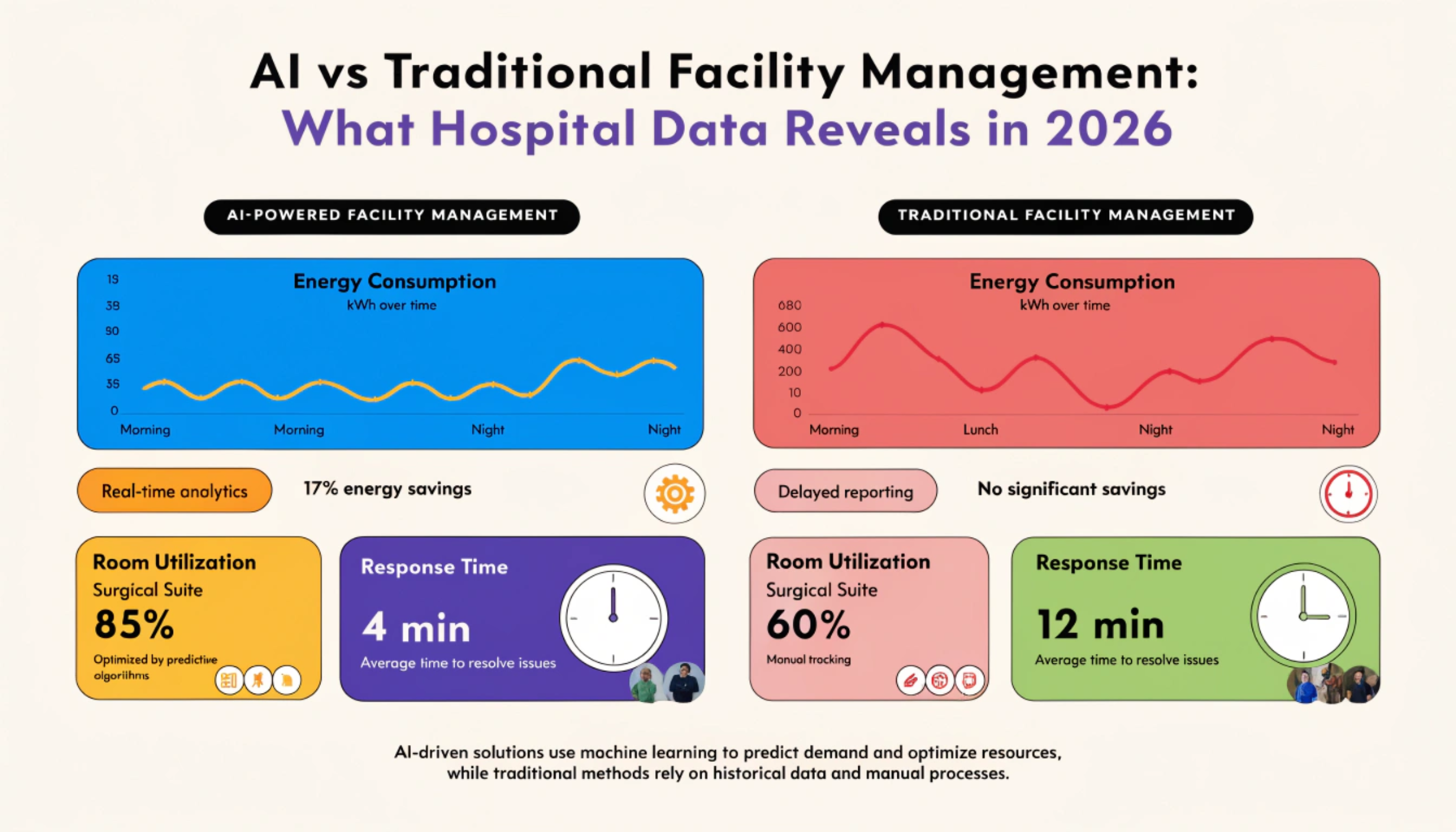
Hospitals are under constant pressure to improve efficiency without compromising patient safety, clinical continuity, or regulatory compliance. Facility management sits at the center of that challenge. Heating, ventilation and air conditioning (HVAC), medical equipment, energy systems, security, maintenance, utilities and environmental controls all have to work reliably around the clock.
For decades, hospitals have largely depended on traditional facility management models built around scheduled inspections, preventive maintenance, manual reporting and reactive repairs. These methods remain important, but the growing availability of sensors, connected building systems and analytics is changing how facility teams operate.
In 2026, the debate is no longer simply about whether artificial intelligence can be used in hospitals. The more important question is whether AI-enabled facility management can deliver measurable advantages over traditional approaches.
Recent healthcare facilities data suggests that the shift is already underway. According to Johnson Controls’ 2026 AI & Digitalization in Facilities Management Report for Healthcare, 65% of healthcare facility managers surveyed are already using AI for areas such as workflow automation, predictive maintenance, compliance reporting and security. However, adoption remains more cautious than in many other industries because healthcare facilities face particularly high safety, cybersecurity and reliability requirements. (johnsoncontrols.com)
Traditional Facility Management Still Has a Role
Traditional facility management is not disappearing in 2026. Hospitals continue to depend on experienced engineers, technicians and facilities professionals who understand the physical infrastructure of their buildings.
A traditional maintenance program usually combines preventive and corrective maintenance. Equipment is serviced according to predefined schedules, technicians inspect systems periodically, and repairs are initiated when faults are reported or equipment fails.
This approach has several advantages. It is familiar, relatively straightforward to manage and does not require hospitals to build sophisticated digital infrastructure. Experienced maintenance teams can also identify unusual equipment behavior that automated systems may initially miss.
The problem is that traditional maintenance is often based on time rather than actual equipment condition.
An air-handling unit, pump or chiller may receive maintenance every three or six months regardless of how it has actually performed. A component could begin deteriorating shortly after an inspection and continue consuming excessive energy until the next scheduled check. In a hospital, that delay can create more than a maintenance expense. It can affect comfort, environmental conditions and operational continuity.
This is where AI hospital facility management begins to create a meaningful difference.
What AI Adds to Hospital Facility Management
AI can continuously analyze data generated by connected building systems rather than relying exclusively on periodic inspections.
Sensors can monitor temperature, humidity, pressure, vibration, energy consumption, equipment runtime and fault conditions. AI and analytics platforms can then identify unusual patterns and flag potential problems before they become major failures.
For example, if a hospital chiller gradually begins consuming more electricity while delivering less cooling, traditional maintenance may identify the issue only during an inspection or after performance noticeably deteriorates. An AI-enabled system can compare current operating behavior with historical patterns and alert the facilities team to investigate.
The objective is not necessarily to allow AI to make every maintenance decision independently. Instead, AI hospital facility management is most valuable when it gives technicians better information earlier.
This creates a shift from reactive maintenance to predictive and condition-based maintenance.
A 2026 study examining IoT-enabled predictive maintenance for hospital HVAC systems similarly highlights the importance of integrating sensing, analytics, decision support and performance feedback. The research notes that hospitals can face limited digital infrastructure, skills gaps and fragmented data, meaning successful predictive maintenance often needs to be implemented in phases rather than through an immediate technology overhaul. (ScienceDirect)
The Data Behind AI Adoption in 2026
The numbers provide an important perspective on where hospitals are actually using AI.
Johnson Controls reports that 65% of healthcare facility managers surveyed are already using AI in facility operations. Among existing users, 45% use AI to automate workflows or streamline maintenance, while nearly half apply AI to predictive maintenance. Looking ahead, 45% of healthcare facility managers planning new deployments expect to implement AI-driven predictive maintenance solutions within the next year. (johnsoncontrols.com)
These figures indicate that predictive maintenance is not merely a theoretical application. It is becoming one of the practical entry points for healthcare facilities adopting AI.
Workflow automation is another major area of interest. Among healthcare facility managers planning to deploy AI, 55% expect automation to be a focus, according to the same 2026 report. (johnsoncontrols.com)
This matters because facility teams spend considerable time handling repetitive activities such as work-order management, reporting, inspections and documentation. Automating these processes can allow skilled employees to spend more time on higher-value maintenance and operational decisions.
AI vs Traditional Maintenance: The Biggest Difference
The fundamental difference between the two models is the way they use information.
Traditional facility management generally asks: When should we inspect or repair this asset?
AI-enabled management increasingly asks: What is the asset telling us right now, and what is likely to happen next?
That distinction can have significant operational consequences.
With traditional preventive maintenance, an asset is serviced according to a schedule. With AI-enabled predictive maintenance, the system continuously evaluates performance and can prioritize maintenance based on condition and risk.
For hospitals, this can be particularly valuable because not every asset has the same level of criticality. A failure involving a non-critical administrative area is different from a failure involving infrastructure supporting an operating room, intensive care area or other essential clinical environment.
AI can help facility managers prioritize attention according to asset condition, operational importance and potential consequences.
However, AI does not automatically make a facility smarter. The quality of its recommendations depends heavily on the quality of the underlying data, sensor coverage, system integration and maintenance processes.
Energy Management Is Becoming a Major AI Use Case
Energy is another area where the data supports the growth of AI hospital facility management.
Hospitals operate continuously and often have demanding HVAC, ventilation, cooling, heating and electrical requirements. At the same time, healthcare organizations face increasing pressure to control operating costs and improve sustainability.
The 2026 Johnson Controls report identifies energy intelligence as a major priority. Among healthcare organizations planning new AI deployments, 75% expect to use AI for energy optimization. (johnsoncontrols.com)
AI can analyze energy consumption across different systems and identify unusual patterns, inefficient operating schedules or opportunities to optimize equipment performance.
Consider a hospital HVAC system operating at a higher capacity than necessary during periods of lower demand. A traditional approach may rely on fixed schedules and manual adjustments. An AI-enabled system can analyze occupancy, environmental conditions, historical consumption and equipment performance to recommend or automatically make appropriate adjustments where the control architecture permits.
The goal is not simply to reduce electricity use. Hospitals must maintain strict environmental conditions. Any optimization strategy therefore needs to balance efficiency with patient safety, infection-control requirements, comfort and clinical needs.
This is one reason healthcare operations AI requires a different approach from AI used in conventional commercial buildings.
Predictive Maintenance Can Change the Cost of Failure
The financial value of predictive maintenance is not limited to reducing repair bills.
An unexpected equipment failure can create a chain reaction. Emergency repairs may require premium labor or replacement parts. Equipment downtime can disrupt operations. Staff may have to manually compensate for unavailable systems. If the affected infrastructure is critical, the operational consequences can become significantly larger.
Predictive maintenance aims to intervene earlier.
If analytics identify abnormal vibration in a pump, increasing energy consumption in a chiller or unusual temperature behavior in an air-handling system, the facilities team can investigate before the problem develops into a major failure.
This does not mean every AI alert will be correct. False positives and inaccurate predictions remain possible. Human validation is therefore essential.
The strongest model is a partnership between AI and facility professionals: AI continuously processes large amounts of operational data, while engineers interpret the findings and decide what action should be taken.
Compliance and Reporting Are Another Advantage
Healthcare facilities generate extensive documentation. Compliance requirements can involve maintenance records, inspections, environmental conditions, safety systems and equipment performance.
Manual reporting can consume substantial amounts of staff time and may create inconsistencies when information is distributed across spreadsheets, paper records and different software systems.
Healthcare operations AI can help consolidate information and automate parts of reporting.
The 2026 healthcare facilities report found that advanced reporting and compliance management was the leading capability healthcare leaders and facility managers wanted to add to improve resilience and efficiency. Twenty-one percent of healthcare leaders and 25% of facility managers selected it as their preferred capability. (johnsoncontrols.com)
The benefit is not just faster reporting. Digitally generated records can provide facilities teams with a clearer operational history, helping them understand recurring problems and demonstrate that maintenance processes are being followed.
Cybersecurity Is the Biggest Warning Sign
Despite the potential benefits, hospitals cannot adopt AI without considering the risks.
Connected building systems create additional digital pathways. When HVAC, utilities, access control, security and other infrastructure are connected to centralized platforms, cybersecurity becomes an essential part of facility management.
Johnson Controls reports that 31% of healthcare facility managers identify data privacy and cybersecurity as the main obstacle to scaling AI, compared with 18% citing budget constraints and 12% citing resistance to change. (johnsoncontrols.com)
This is a critical distinction between healthcare and many other industries.
A hospital cannot simply connect every building system to an AI platform without considering patient safety, privacy, network security, system reliability and operational continuity.
Successful AI hospital facility management therefore requires cybersecurity to be considered from the beginning rather than added after implementation.
Why Traditional and AI-Based Models Will Coexist
The evidence does not suggest that hospitals should replace traditional facility managers with AI.
Instead, the likely future is a hybrid model.
Technicians will continue performing physical inspections, repairs and preventive maintenance. Engineers will continue making decisions based on experience and professional judgment. AI will increasingly provide continuous monitoring, pattern recognition, predictive alerts and automated reporting.
This combination is particularly important because hospital infrastructure can be complex and unpredictable. An algorithm may detect that a system is operating outside its normal range, but an experienced engineer may understand that the change is intentional because of construction work, a clinical requirement or a temporary operational condition.
Human expertise provides context. AI provides scale.
That combination is likely to become the defining characteristic of modern healthcare facilities management.
The Biggest Barrier May Not Be Technology
Hospitals often have legacy equipment and disconnected systems. Installing an AI platform does not automatically integrate those systems.
Data may be incomplete, inconsistent or stored in different formats. Older equipment may lack modern sensors. Facility teams may not have sufficient experience with analytics. Budgets may also favor urgent infrastructure requirements over digital transformation.
The 2026 research on hospital HVAC predictive maintenance emphasizes this readiness challenge, finding uneven digital infrastructure, skills and data integration even though HVAC systems are highly critical. (ScienceDirect)
For this reason, hospitals should avoid approaching AI as a single large technology project.
A better strategy is to start with high-value assets and clearly defined use cases. Digitizing maintenance records, connecting critical equipment, establishing reliable sensor data and building basic dashboards can provide the foundation for more sophisticated predictive analytics later.
What Hospitals Should Do in 2026
The most practical approach is to begin with business problems rather than technology.
Hospitals should identify equipment where failures create significant operational or financial consequences. HVAC systems, chillers, pumps, electrical infrastructure and other critical assets can then be evaluated for available data and sensor coverage.
The next step is to establish a reliable digital foundation. Without trustworthy data, even sophisticated AI models will produce limited value.
Facilities teams should also define how AI alerts will be handled. An alert without a clear workflow is simply another notification. Hospitals need processes that determine who receives an alert, who validates it, how a work order is created and how the result is documented.
Finally, performance should be measured. Metrics such as unplanned downtime, maintenance response time, energy consumption, asset availability, maintenance costs and number of recurring failures can help determine whether an AI initiative is actually delivering value.
The 2026 Outlook: From Reactive Buildings to Intelligent Facilities
The data from 2026 suggests that AI is moving from experimentation toward practical facility applications in healthcare.
With 65% of surveyed healthcare facility managers already using AI and strong interest in predictive maintenance, workflow automation, energy optimization and compliance reporting, the technology is becoming part of the broader smart-hospital strategy. (johnsoncontrols.com)
But adoption will remain deliberate. Hospitals have less tolerance for operational uncertainty than many other industries, and cybersecurity, data quality and system integration remain significant challenges.
The future therefore will not be about AI replacing traditional facility management. It will be about making traditional expertise more powerful.
A technician who once relied on periodic inspections can increasingly receive condition-based alerts. A facility manager who once reviewed monthly energy reports can access continuous performance intelligence. A maintenance department that once responded to failures can increasingly anticipate them.
That is the real opportunity of AI hospital facility management in 2026: not replacing people, but giving hospital teams better information, earlier warnings and more intelligent ways to manage increasingly complex facilities.
As hospitals continue investing in connected infrastructure and smarter operations, the organizations that successfully combine human expertise, reliable data and healthcare operations AI will be better positioned to improve resilience, efficiency and long-term facility performance.
Ready to explore the future of smart healthcare facilities? View all upcoming BMA events and discover where healthcare leaders are discussing the technologies shaping next-generation hospital operations.